

Labour, capital and commodity markets are evolving rapidly across Australian agriculture.
Businesses that once relied on instinct, proximity and the strength of a handful of trusted leaders are now operating in environments defined by scale, scrutiny and commercial precision. In this context, succession planning is no longer a distant ownership conversation or a contingency for retirement. It is a strategic leadership decision about resilience, margin protection and long-term performance.
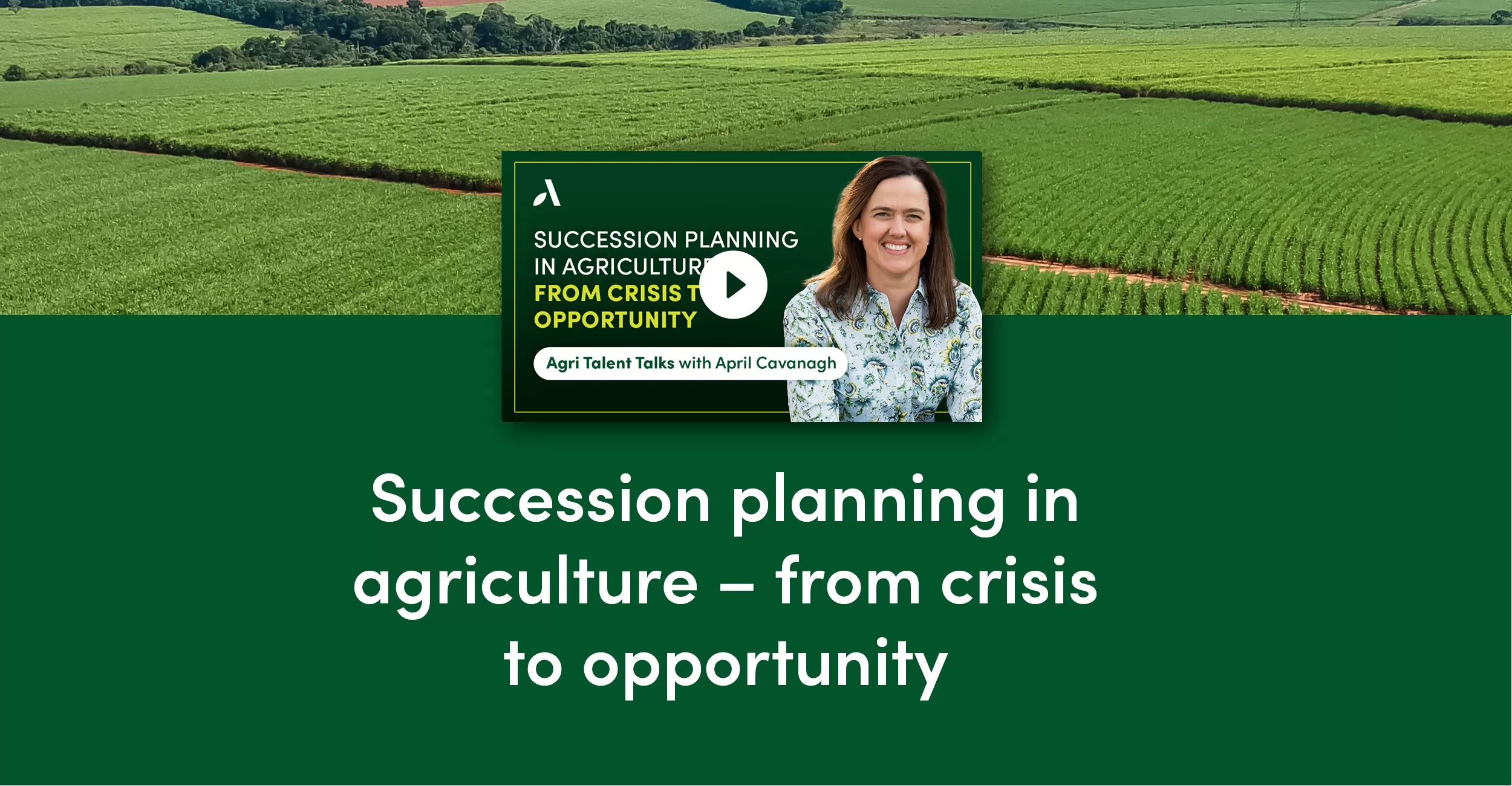
As discussed in our latest episode of Agri Talent Talks with April Cavanagh, the most successful agribusinesses are those recognising that growth demands structure, depth and deliberate capability building rather than dependency on a few key individuals.
As April recently observed in conversation during our latest episode of Agri Talent Talks:
“It can be the old adage of continuing to rely on just one or two key people when the business has outgrown that structure and times have changed.”
This is where succession planning shifts from being a reactive measure to a strategic opportunity.
When growth outpaces structure
For many agribusinesses, success has been built on the capability, relationships and drive of a small number of key individuals.
Australian ag has long earned its reputation for productivity, resourcefulness and trust-based partnerships. However, as businesses scale, complexity increases. Larger teams, broader domestic and international markets combined with tighter compliance requirements are now part of daily operations. Supply chains have become more sophisticated, investor scrutiny has intensified and technology adoption is accelerating.
In this environment, organisational structures that once worked well can quickly become stretched. What was manageable at a smaller scale becomes a risk at a larger one – and structural fragility becomes expensive.
April describes the businesses performing best today as those who are deliberate about succession right now. They recognise that while one or two leaders may have carried the business through its early stages, sustainable performance requires depth and ongoing transformation.
Commercial clarity is the foundation
High-performing leaders have always shared certain traits. They’re crystal clear on the economics of their business. They know what makes the money. Importantly, it is not ego, size or output that drives results.
“It’s not the biggest animal or the biggest crop that automatically gets the best return. It’s about timing, input costs and margin.”
Succession planning is directly connected to this commercial discipline. If your business knows exactly what drives margin, you must ensure that knowledge is not concentrated in one individual. When commercial insight, market intelligence or operational strategy sits in a single head, risk multiplies. The strongest businesses are spreading that capability and knowledge by bringing others into the decision-making. That is succession in action.
From key-person dependency to leadership depth
Succession planning in agriculture is often misunderstood as a future ownership event. In reality, it is a present-day leadership strategy. It asks:
- Has our business outgrown its current structure?
- Do we have genuine second-tier leaders?
- Can the business operate at full performance if one key person steps back?
- Is accountability distributed, or concentrated?
The best leaders balance autonomy with clear performance expectations. In high-performing agribusinesses, flexibility is not seen as a weakness but as a strength. Leaders understand they do not need constant visibility over their teams in order to drive results. Instead, they focus on outcomes, ensuring individuals have the autonomy to operate while remaining accountable for productivity and performance.
Strong agricultural leaders maintain a culture built on trust, but they pair that trust with structure and clarity. Expectations are understood, responsibilities are defined and accountability sits alongside independence. Trust without structure creates risk, while structure without trust erodes culture. Effective succession planning reinforces both, embedding accountability into the organisation while preserving the flexibility and ownership that define the sector at its best.
Knowledge transfer is no longer optional
In today’s environment, knowledge must move. Whether through leadership development, structured delegation or even technology adoption, the goal remains to ensure that capability is embedded in the business, not trapped in individuals. As April noted during our interview:
“AI helps with your succession so that knowledge isn’t stuck in one person’s head.”
Documentation, systems and governance support this process. But people remain central. In fact, succession planning often requires strategic hiring.
That might mean:
- Appointing a COO to professionalise operations
- Recruiting a commercial manager to sharpen margin discipline
- Building out a senior leadership team
- Introducing independent board capability
- Strengthening finance or supply chain oversight.
These are not signs of weakness. They are signs of maturity and future-planning capabilities.
The shift from survival to strategy
Today, the value proposition of agriculture is stronger than ever. The challenge is not convincing people to stay in ag – it is building structures that retain and develop them.
That shift has driven more strategic workforce planning across the sector. The most progressive agribusinesses are not waiting for a crisis to trigger change, they are building leadership depth while conditions are strong. That is how succession moves from a defensive exercise to a growth lever.
Where Agri Talent fits into your succession planning
At Agri Talent, succession planning is not treated as a standalone document or a once-off conversation. It is embedded in how we approach both permanent recruitment and executive search.
Our consultation-led process starts with understanding:
- What makes money for your business
- Where commercial accountability sits
- How decisions are made
- Where knowledge is concentrated
- Whether your current structure supports the next phase of growth.
Many agribusinesses have outgrown reliance on one or two key people. Identifying that inflection point early protects productivity, margin and long-term value. Succession is not about replacing people – it is about building depth, clarity and resilience into your organisation.
Because the strongest businesses are deliberate. They understand that leadership capability is not accidental. It is designed.
Spreading knowledge and building depth in your team starts with the right hires. Get in touch with Agri Talent to talk about your succession strategy.