

Finding the right talent for an aquaculture operation has never been straightforward. Over the next three years, the process will become even tougher.
Why? Put simply, Australia’s aquaculture talent supply is not keeping pace with sector growth. The industry accounts for an estimated 58% of the total value of the fisheries and aquaculture sector, with ABARES forecasting production to reach $2.21 billion and 307,000 tonnes by 2028–29. Yet the core workforce remains remarkably small.
In fact, Jobs and Skills Australia profiles suggest there are around 1,000 aquaculture workers nationally. That’s a constrained labour market for an industry of this weight, particularly considering it’s concentrated almost entirely in regional Australia where every hire is harder, and every vacancy costs more.
With production forecast to keep growing, the window to get workforce planning right is now. For business leaders with growth on the horizon, talent availability belongs in the same conversation as capital planning. Securing the right people requires a focus on industry-focused talent acquisition to keep operations running smoothly.
Here, we cover the roles employers will struggle to fill, the commercial realities behind them, and what aquaculture businesses are doing to get ahead of it.
The aquaculture talent supply-demand gap: why the next 3 years are critical
Our observations at AgriTalent show that the Australian aquaculture sector has reached a major turning point. Production volumes are expanding quickly to meet global seafood demand, yet the pool of skilled people remains static. This gap creates immediate operational risks for businesses planning to scale up over the next three years.
The reality of regional labour makes this shortage harder to manage. Most operations sit in remote coastal areas where local hiring pools are small or non-existent.
When businesses cannot find staff locally, they must convince workers to move their families to these areas. This step slows down the hiring process and increases recruitment costs.
Because of these factors, the next few years will decide which businesses can successfully expand. Companies that treat workforce design as a core part of their commercial planning will secure the limited talent available. Waiting until a project is finished to look for staff will lead to major operational delays.
Critical leadership roles: the talent shortage at the top
Leadership shortages in aquaculture pose a major risk because their consequences are felt across all areas of production, compliance and site performance.
Over the next three years, these roles are likely to be the hardest to fill:
- General or operations managers
They are especially difficult to fill because the candidate pool is small, and much of the value sits in site-specific knowledge. In regional operations, vacancies are difficult to absorb and slow to backfill.
- Hatchery managers
Few roles have a more direct impact on production continuity. The pathway into hatchery leadership is narrow, and few candidates bring the necessary mix of technical and operational experience.
- Fish health leads or aquaculture veterinarians
As biosecurity and environmental pressure rise, so too does the demand for these roles. The market is tight, particularly for candidates with practical aquaculture experience. Industry evidence shows these roles can remain unfilled despite strong remuneration.
- Production managers
Bridging technical and operational disciplines, production managers with genuine aquaculture experience across species like Atlantic salmon, barramundi and prawns are consistently challenging to source.
For organisations undertaking executive search for aquaculture leadership roles, lead times can be longer than expected. This delay happens because most suitable candidates are already in roles or are not actively job hunting.
Operational roles creating production and growth bottlenecks
While leadership roles carry the highest risk, operational roles are where constraints show up day to day. Gaps at this level usually show up first in output, consistency and increased pressure on existing teams. They are harder to absorb because the work still needs to happen, even when the role is vacant.
The roles most likely to create bottlenecks include:
- Aquaculture supervisors
Supervisors are difficult to replace quickly. Most come through internal progression, so one promotion often creates another gap elsewhere in the operation.
- Experienced hatchery and production technicians
Stock handling, monitoring and feeding depend on people who know the systems and can work consistently. In hatchery settings especially, small mistakes can lead to larger downstream consequences.
- Maintenance and engineering roles
Site performance depends on reliable electrical and mechanical capability, particularly as operations adopt more automation. Competition from mining, energy and utilities makes attraction and retention more challenging.
- Processing and production supervisors
As processing capacity expands, the need for experienced supervision expands with it. Many businesses do not feel the impact until throughput starts to tighten.
Left unfilled for long, these roles affect output, drive up overtime and put pressure on the teams already stretched across other gaps.
Emerging roles driven by technology and sustainability
The job of running an aquaculture operation looks different to what it did five years ago, and it will look different again in five more.
Automation is a big part of that. Huon Aquaculture’s Storm Bay operation is already managed from a control room in Hobart, with staff interpreting AI-driven feeding data rather than working manually on the water.
Huon has also committed $110 million to a new RAS (recirculating aquaculture systems) facility in Port Huon, due to be operational by 2027, via the Whale Point Nursery Expansion. The Blue Economy CRC is developing autonomous sensor networks for Tasmanian oyster farms, with Tassal and Huon among its industry partners.
Globally, computer vision tools for stock grading and deep learning models for production forecasting are becoming more common. The expectation that operational staff can work confidently alongside these systems is growing with them.
On the sustainability side, FRDC, Seafood Industry Australia and the Blue Economy CRC are investigating how aquaculture operations reduce emissions and energy costs across land and sea-based production. That work will eventually need people on the ground to implement it.
The roles emerging from this are still relatively new to Australian aquaculture. Few have an established talent pool, and most employers are either competing for a small group of people or developing the capability from within. They include:
- Automation and systems operators: Managing remote feeding, sensors and monitoring platforms across multiple sites.
- Environmental monitoring and compliance leads: Interpreting water quality data, meeting reporting obligations and managing regulatory risk.
- RAS technicians and systems managers: Land-based production requires a fundamentally different technical skill set from sea-based farming, and the candidate pipeline for these roles in Australia is still in its infancy.
- Energy and infrastructure specialists: As decarbonisation moves from research into operations, sites will need staff who understand both production and energy resilience.
Regional location: the multiplier effect on talent scarcity
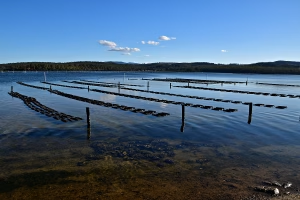
The bulk of Australian aquaculture happens in areas that are genuinely hard to recruit into. Examples include Tasmania’s D’Entrecasteaux Channel and Macquarie Harbour, South Australia’s Spencer Gulf, Western Australia’s Exmouth Gulf, and the Gulf of Carpentaria. These are challenging places to uproot a family and move to, regardless of how good the role is.
In a sector that already faces a thin specialist workforce, location makes hiring much harder.
Oysters Tasmania’s submission to Jobs and Skills Australia found that roles across every aquaculture occupation category in Tasmania are proving difficult to fill, even with strong remuneration on offer. Salary is not the only factor that makes or breaks the decision. Housing, schooling, a partner’s career prospects, and the local community all weigh just as heavily.
For employers, that means recruiting for regional aquaculture operations looks quite different from a standard search. It takes longer, requires a wider net and depends on how well the opportunity is positioned as a life decision, rather than just a career one. Businesses should focus on regional talent attraction early in their planning to fill these positions successfully.
The succession planning crisis: no one’s talking about it, everyone’s facing it
A lot of what keeps an aquaculture operation running lives in one person’s head. It might be the farm manager who knows how a water system behaves across seasons, or the hatchery lead with years of species-specific protocols. When those people leave, that knowledge often leaves with them.
This concentration of knowledge creates a commercial risk for aquaculture businesses, because the workforce is small and roles take years to develop. A sudden vacancy can cause production delays, slow down choices, and stall growth timelines at the same time.
The roles with the highest succession risk are the same ones that are hardest to replace: the leadership and technical positions where the candidate pool is thinnest and the time to develop a replacement is longest. Those are the roles to prioritise.
The businesses handling this well have stopped waiting for a trigger. They are asking now whether critical knowledge and accountability are distributed across the team, or still sitting with one or two people.
Our article on succession planning in agriculture explores how operators are bringing others into the decision-making before a vacancy forces their hand.
Commercial impact: how talent shortages affect the bottom line
Talent gaps in aquaculture cost money in ways that are easy to underestimate. When critical roles sit vacant, delayed commissioning and inconsistent output feed directly into revenue, pushing back returns from new infrastructure and making contracts harder to fulfil. And with aquaculture farmers already averaging 46 hours a week, overtime climbs quickly when existing teams absorb the load.
Market salary guides place aquaculture and fisheries production managers at $5,440–$8,813 per month. A prolonged vacancy at that level carries a steep cost in overtime loading, delayed decisions and deferred revenue, before a replacement is even found.
Operational delays also directly damage yield efficiency. For instance, if a production supervisor role stays vacant, daily feeding schedules can fall out of alignment. Our industry data shows that a mere 5% drop in feed efficiency from unoptimized feed waste can cost a mid-sized land-based operation upwards of $15,000 per week in lost biomass conversion.
Biosecurity is where the financial exposure gets most serious. Disease events in Tasmanian Atlantic salmon operations have caused significant stock losses, and mass mortality events cost the global salmon industry billions annually. Adequate fish health leadership is one of the few controllable variables in that equation.
So, for a sector forecast to reach $2.21 billion by 2028–29, the cumulative cost of workforce gaps compounds quickly.
Strategic responses: what forward-thinking aquaculture employers are doing
Businesses that manage talent risk well have stopped treating workforce planning as a hiring function. It sits alongside capital and expansion planning, and it starts well before a role becomes vacant. Here is what that looks like in practice:
Starting the search well before the role is needed
When filling aquaculture leadership roles, the businesses that secure the top candidates are those that begin the process well before the vacancy becomes urgent. The candidate pool is much too small to only rely on speed.
Broadening the candidate pool
Large-scale livestock and poultry operations produce candidates with genuinely transferable skills in animal husbandry, biosecurity awareness, production scheduling and team leadership. With structured induction, these candidates can transition successfully into operational roles in aquaculture.
Using international recruitment strategically
Norway, Chile, New Zealand and the UK all have established aquaculture industries and experienced workforces. As Oysters Tasmania notes, skilled migration is a structurally sound response to Australia’s domestic supply constraints. This approach helps fill technical and scientific roles where the local pipeline is lean.
Investing in internal development
In a market where external recruitment is slow and competitive, building internal pathways is a legitimate strategy. Identifying which technicians and supervisors have leadership potential and developing them deliberately reduces dependency on the external market for critical roles. This method also keeps operational knowledge inside the business.
The talent market reality: what to expect over the next 3 years
The aquaculture labour market is not going to ease on its own. Based on what the data shows and what we’re seeing in the market, here is our read on the next three years:
Pressure on leadership and technical roles will intensify
Production is forecast to grow. The specialist workforce supplying it is not keeping pace, and that gap will widen as more operations scale.
Technology will raise the bar on candidate requirements
With significant capital already committed to RAS, automation and environmental monitoring, the baseline technical literacy expected of operational staff will rise. Candidates who can bridge production experience with systems confidence will become harder to find.
Regional recruitment will remain a structural challenge
The barriers making coastal and remote locations difficult to recruit into are not going away. Employers without a deliberate regional attraction strategy will feel it most in their hardest to fill roles.
International recruitment will become a more deliberate lever
As domestic supply constraints persist, skilled migration will move further into mainstream workforce strategy for Australian aquaculture businesses, particularly for technical and scientific roles where the local pipeline is thin.
That said, none of these challenges are without a solution. Businesses that plan early and recruit strategically are better positioned for the growth ahead.
Agri Talent: experienced aquaculture recruitment in Australia
In a sector this specialised, the strongest candidates are seldom found through a job ad. AgriTalent supports permanent and executive recruitment across Australian aquaculture, filling over 80% of roles without advertising across Atlantic salmon, barramundi, tuna, prawns, oysters and trout.
If you’re planning for growth, succession or critical hires, start the conversation early. Discuss your aquaculture workforce strategy
Frequently asked questions
Should we recruit from international markets or develop Australian talent?
It depends on the role. For highly specialised positions where the domestic pipeline is thin, including hatchery scientists, fish health professionals and senior species-specific technicians, international recruitment is often the most viable path. For supervisory and operational roles, the search does not have to be limited to aquaculture experience. Australian candidates from livestock, dairy and food processing bring transferable skills in animal husbandry, biosecurity, production scheduling and team leadership.
How far in advance should we plan for critical leadership succession?
For farm manager and hatchery manager roles, 12 months is a great starting point. For general manager and senior technical leadership roles, allow 18 to 24 months, particularly where regional relocation or species-specific experience is required. Most candidates at this level are already in roles, so early planning gives you more options and reduces hiring risk.
What salary premiums should we expect for regional aquaculture roles?
Salary guides place aquaculture manager roles at around $93,000 to $97,000 at the median, with production and operations managers often earning more, depending on scale, species, and location. In regional aquaculture, salary is one of several factors. Relocation support, role scope, family considerations and career pathway all influence whether a candidate chooses to move.
Can we attract experienced food production managers into aquaculture?
Yes, particularly from livestock, poultry, and food-processing backgrounds. Biosecurity awareness, production scheduling and team leadership all transfer well. Species-specific and water systems knowledge can be built through structured onboarding, mentoring and time on-site.
How do we compete with corporate aquaculture operations for talent?
Corporate operators have advantages in structured career pathways and compensation. However, they also tend to move slowly, offer less autonomy and give individuals less influence over outcomes. Smaller, family-owned operations compete well by offering meaningful leadership scope, direct access to ownership, and the ability to see the impact of decisions quickly. For some candidates, that is a more attractive proposition than a corporate role.
Is it realistic to develop technical specialists internally, or must we recruit?
It depends on the role. Aquaculture veterinarians, fisheries scientists and advanced biosecurity roles usually require external recruitment because the qualification pathways are long and specific. Supervisory and mid-level technical roles can be more realistic to develop internally, especially when businesses identify candidates early and give them a clear pathway.