

Corporate agricultural enterprises often clear major production hurdles only to find their commercial expansion restricted by severe distribution deficits. Across Australian agriculture, agribusiness supply chain recruiters are seeing a clear trend where capital deployment and market access are increasingly constrained by a systemic shortage of executive-level logistics capability. Long-term monitoring of the agricultural sector highlights how local farming methods have improved fast over the last ten years, resulting in record-breaking yield volumes that place unprecedented strain on downstream transport networks.
As businesses scale, expand into new markets, or integrate vertically, the supply chain becomes highly complex. This operational complexity makes leadership gaps incredibly costly. Sub-optimal freight allocation directly erodes margins. Large-scale corporate beef operations, multi-station pastoral properties, and vertically integrated processors require sophisticated executive management to preserve asset yields, maintain cold-chain integrity, and protect investor returns.
The supply chain talent squeeze: What is actually happening in the agribusiness market
The market is tightening due to compounding structural shifts across the national Australian workforce:
- Increased demand across multiple industrial sectors, driven by infrastructure booms and renewable energy logistics.
- Intense poaching from FMCG, major retail groups, and global third-party logistics firms operating with larger capital reserves.
- A highly restricted domestic supply of experienced personnel who possess both technical distribution expertise and agricultural domain knowledge.
- Severe succession pressures within family-owned enterprises and pastoral companies where exiting founders lack capable internal leadership replacement.
This has made supply chain recruitment agribusiness significantly more competitive. Our ongoing analysis of national workforce intelligence for agribusiness shows that many companies now look for workers at the exact same time. This widespread corporate demand, combined with severe regional labor shortages across northern and western agricultural corridors, leaves senior vacancies unfilled for extended durations.
Why supply chain leadership has become a strategic priority, not a back-office function
As the overall value of agricultural production scales up toward historic highs, the supply chain has evolved into a front-line business driver. Modern farming relies heavily on highly coordinated, temperature-controlled transit corridors to preserve product shelf life and capture premium export pricing. Good transport networks help businesses move goods to ports without delay, directly impacting corporate performance indicators:
- Revenue timing and cash flow optimization.
- Working capital management and freight cost control.
- Contractual compliance and overseas customer satisfaction.
- Geographic market access and trade lane diversification.
This gives leadership roles a strategic importance. Executive leaders must navigate multi-modal freight disruptions, optimize fuel hedging strategies, and engineer distribution networks that insulate the business from macroeconomic shocks. Their daily choices alter the financial health of the entire company.
The leadership roles creating the biggest bottlenecks in agribusiness supply chains
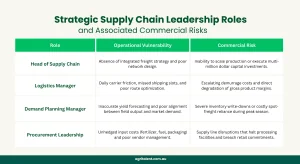
Based on current sector data and operational trends, specific management shortages pose the greatest risk to commercial expansion. Vacancies in these roles create immediate operational strain. Teams often work without clear direction when these positions stay empty. Shipping schedules fail when no person supervises the daily plan.
Why agribusiness is losing the supply chain talent race to other sectors
Supply chain leaders are being attracted to recruitment and fast-paced talent placement within the FMCG sector, retail organisations, and global logistics firms. These businesses usually operate out of large modern offices in major capital cities, utilising substantial capital backing to secure top-tier national talent. These sectors often offer:
- Higher salaries backed by corporate performance bonuses.
- Urban locations requiring minimal corporate relocation or long-distance travel.
- Perceived career growth within globalized corporate frameworks.
Rural companies sometimes struggle to match these city benefits. The operational realities of operating out of remote regional processing hubs or broadacre corporate offices present lifestyle challenges that require sophisticated, strategic talent positioning to overcome.
The commercial cost of a supply chain leadership gap
Impacts include:
- Increased logistics costs and exposure to volatile spot-freight markets.
- Delayed product delivery resulting in contractual penalties with major supermarket chains.
- Inventory inefficiencies, particularly regarding cold-storage bottlenecks.
- Lost sales opportunities due to an inability to guarantee volume delivery to export markets.
Faced with compounding operational pressures and logistics network vulnerabilities, these costs compound quickly at scale without highly strategic management. Perishable agricultural products depreciate rapidly when logistics coordination fails, leading to immediate revenue write-offs. Furthermore, international export buyers will swiftly reallocate their purchasing contracts to global competitors if delivery schedules miss strict port-of-entry windows.
How to diagnose whether your supply chain problem is a leadership problem
Agribusiness boards and chief executives should evaluate whether internal logistics friction stems from structural issues or a lack of strategic oversight. Warning signs include:
- Repeated operational inefficiencies despite significant investment in fleet capital assets.
- Poor forecasting accuracy that routinely mismatches production output with port capacity.
- High logistics costs that consistently exceed seasonal industry benchmarks.
- Lack of strategic planning regarding long-term freight security and rail or port infrastructure access.
Often, these are symptoms of leadership gaps rather than systems issues. New software cannot fix a basic lack of team direction. Human managers must guide the staff to use these digital tools correctly.
Building a supply chain leadership pipeline that supports growth

To mitigate long-term operational risk, forward-thinking agricultural enterprises adopt a dual-horizon talent model:
- Invest in formal internal development and cross-functional training to ready mid-level operations managers for strategic roles.
- Maintain active external talent pipelines through ongoing industry monitoring and continuous talent mapping.
- Utilise targeted executive search methodologies to secure high-caliber external leaders for highly technical distribution roles.
This helps maintain continuity and scalability. Companies must plan for the future before older workers retire. Regular training helps junior staff prepare for promotion early.
What high-growth agribusinesses are doing differently to secure supply chain leaders
Top-tier pastoral firms and food processors insulate their networks from talent shortages by implementing advanced talent acquisition strategies:
- Treat supply chain management as a primary competitive advantage rather than a simple operational cost center.
- Invest in leadership recruitment twelve to eighteen months ahead of major capital expansions or facility upgrades.
- Benchmark total compensation packages against metropolitan FMCG and industrial logistics markets to remain competitive.
- Partner with dedicated industry specialists to access passive candidate networks based on the latest talent market outlook for agribusiness.
Top companies look at salary trends in other major industries. They offer great packages to keep their best workers from leaving.
Choosing the right recruitment partner for agribusiness supply chain leadership
For critical roles, engaging specialist broadacre recruitment consultants and agribusiness supply chain recruiters helps secure:
- Access to relevant candidates who are not active on public employment platforms.
- Faster hiring timelines by utilizing pre-mapped talent networks across the agricultural sector.
- Better alignment between regional operational realities and corporate commercial expectations.
Specialist recruiters know which managers are looking for new jobs. They talk to active candidates in the market every day. To optimize long-term workforce capability, enterprises should implement professional executive search for agribusiness supply chain solutions, establishing robust operational leadership to drive commercial returns.
Conclusion
Supply chain leadership is now a defining factor in agribusiness performance. Companies need strong direction to handle national transport issues. Good management keeps goods moving smoothly from farms to families.
Without the right capability, growth slows, costs increase, and opportunities are missed. Delayed decisions can cause a business to fall behind its competitors. Sound human resource planning protects the long-term future of the farm.
Contact our specialists to discuss your broadacre workforce strategy and discover how specialized senior supply chain recruitment can transform your logistics network into a primary driver of commercial growth.
Frequently Asked Questions
What supply chain leadership roles are most likely to become growth bottlenecks in agribusiness?
The positions that present the highest commercial risk when vacant are Heads of Supply Chain, Logistics Directors, and Senior Demand Planners. These executive roles govern multi-million dollar freight allocations, dictate regional carrier partnerships, and establish the distribution frameworks required to support corporate farm expansion and processing volume increases.
Why is it so difficult to recruit experienced supply chain leaders in agribusiness?
The modern talent deficit is driven by intense competition from metropolitan FMCG, heavy logistics, and resources companies that actively poach skilled professionals. Furthermore, the agricultural sector’s increasing push toward advanced post-harvest processing requires a highly sophisticated class of supply chain executive, shrinking the pool of qualified talent available for regional placement.
What salary should we expect for a Head of Supply Chain or Supply Chain Director in agribusiness?
Remuneration for executive supply chain roles must be benchmarked against national logistics and FMCG corporate standards to attract high-performing talent. Agribusinesses must be prepared to offer competitive base salaries paired with short-term incentive bonuses and regional relocation assistance to secure top-tier candidates.
Can we attract supply chain leaders from outside agribusiness into our sector?
Yes. Leaders from fast-paced retail food distribution, industrial manufacturing, and metropolitan third-party logistics possess highly transferable skill sets. These executives find tremendous value in the scale, vertical integration, and complex international trade dynamics offered by modern corporate agribusiness enterprises.
How long does it typically take to fill a senior supply chain role in agribusiness?
The standard timeline spans 6 to 12 weeks, depending on the specific technical requirements of the role and the geographic location of the corporate headquarters. Sourcing leadership for remote, asset-attached processing facilities or distant pastoral hubs requires a comprehensive talent search to find candidates whose professional competencies align with regional lifestyles.
Should we use executive search for supply chain leadership roles in agribusiness?
Yes. Senior supply chain positions dictate overall corporate profitability, making executive search the most effective methodology to mitigate hiring risk. This proactive approach allows enterprises to map the entire market and directly approach high-performing, passive leaders who are currently employed by competitors and not browsing active job advertisements.