


The decision between using FMCG recruitment specialists or generalist recruiters is often treated as a standard corporate procurement choice. In reality, it is a high-stakes commercial risk decision that directly impacts long-term hiring outcomes, operational business performance, and capital growth execution. As executive leaders steer complex supply chains through tight margins, they must contend with stark realities highlighted by Jobs and Skills Australia, which reveals that national recruitment difficulty rates remain stubbornly high at 47% for regional areas, leaving over 42% of employers unable to fill critical operational vacancies within a month.
The management of a highly volatile asset base across regional Australia is a massive logistical feat. Food and beverage manufacturing represents the largest sector of Australian manufacturing, meaning operational success depends heavily on securing elite management talent. Even when processing volumes are directly influenced by broader primary production shifts, such as fluctuations in national beef cattle herd numbers, the primary commercial challenge lies in downstream processing, cold chain efficiency, and retail execution. In this high-pressure environment, understanding when to engage FMCG recruiters Australia businesses trust with specialised capability is the baseline for protecting operational performance.
At a glance: When should you use an FMCG recruitment specialist?
For many entry-level or administrative positions, a generalist recruiter may be sufficient. However, an FMCG recruitment specialist is often the better choice when:
- You’re hiring senior operational, commercial or executive leaders.
- The role requires specialist FMCG industry knowledge or established candidate networks.
- The cost of a poor hire could impact production, supply chains or profitability.
- You’re recruiting for difficult-to-fill leadership or technical positions.
- The business is focused on long-term growth rather than simply filling a vacancy.
If your recruitment needs involve business-critical roles where hiring decisions directly influence commercial performance, partnering with an FMCG recruitment specialist is generally the lower-risk option.
The difference between a generalist recruiter and a genuine FMCG specialist
A generalist recruiter offers a wide breadth of transactional database placements, whereas a genuine sector specialist provides deep, authoritative market precision.
| Deploy generalist agencies when… |
|
| Deploy FMCG recruitment specialists when… |
|
Genuine FMCG recruitment specialists deliver commercial value through deeply embedded networks, maintaining active relationships with passive executive talent who are steering successful operations rather than searching job boards. This network depth provides first-hand knowledge of retail compliance, trading terms, and major supermarket channel negotiations.
These experts bring proven experience placing commercial leaders who protect corporate margins, optimise cold chain logistics, and handle strict processing deadlines. Because they understand the functional environment, they assess candidate capability in real-world contexts. They evaluate true historical performance against concrete operational metrics instead of accepting surface-level resume statements.
In contrast, generalist agencies often introduce operational risks due to specific service gaps. They lack immediate access to high-tier FMCG talent pools because they rely on public advertisements that miss passive industry professionals. This issue is compounded by a lack of detailed knowledge regarding specialised role requirements and grocery channel capability.
Ultimately, a lack of market credibility prevents generalists from building trust with elite industry leaders because they cannot talk authoritatively about specific operational pressures, trade spend optimisation, or factory compliance.
What generalist recruiter mistakes look like in FMCG hiring
An over-reliance on active job seekers via generic public job boards treats specialised recruitment as a standard volume exercise. This practice floods a hiring manager’s desk with resumes from individuals who are actively looking but lack the highly specific technical expertise required for advanced food manufacturing environments.
The operational mismatch is worsened by a fundamental misalignment between candidate experience and nuanced operational needs, resulting in the presentation of candidates with general corporate credentials who frequently struggle when exposed to the high-volume, fast-paced, and target-heavy realities of modern automated processing facilities.
Furthermore, a poor, surface-level understanding of retail channel requirements results in a failure to screen candidates for their specific history of handling intense, high-stakes category reviews with major retail accounts.
Finally, ineffective role positioning in a highly competitive market occurs because generalist recruitment agencies frequently approach corporate food firms with standard commercial strategies. This approach demonstrates a complete failure to grasp the nuance of persistent sector-wide skills shortages that require deep, long-term talent cultivation rather than quick transactional headhunting.
This structural approach directly leads to:
- Significantly longer hiring timelines that prolong vacant periods for business-critical seats while internal teams spend hours filtering through subpar, non-compliant candidate shortlists.
- Lower-quality, irrelevant shortlists that force corporate leaders to interview candidates who lack basic industry literacy regarding cold chain integrity, food safety regulations, or trade spend management.
- A dramatically increased risk of an expensive mis-hire that places an ill-equipped leader into a vital commercial position, which inevitably results in operational friction, cultural erosion, and a rapid return to the recruitment market within twelve months.
The FMCG roles where specialist recruitment matters most
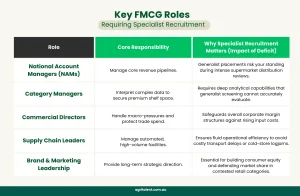
Specialist recruitment becomes essential for key functional positions where a performance deficit directly impacts bottom-line revenue.
- National Account Managers (NAMs): These professionals manage the core revenue pipelines of your business. The placement of an unvetted manager through a generalist agency directly risks your standing during intense supermarket distribution reviews.
- Category Managers: These specialists are tasked with interpreting complex data to secure premium shelf space, which requires deep analytical capabilities that generalist screening processes simply cannot accurately evaluate.
- Commercial Directors: Leaders in these roles handle macro-pressures, protect trade spend, and safeguard overall corporate margin structures against rising input costs.
- Supply Chain Leaders: For automated facilities, these individuals act as critical operations executives who must ensure high-volume environments run with perfect fluid efficiency to avoid costly transport delays or cold-store logjams.
- Brand and Marketing Leaders: These executives provide the strategic direction responsible for building long-term consumer equity and defending market share in highly contested retail categories.
These high-stakes roles strictly require:
- Deep, uncompromised industry knowledge to ensure that raw agricultural commodities transition seamlessly into highly regulated consumer-packaged goods.
- Strong, instantly accessible peer networks to yield the professional clout required to attract high-performing functional managers and specialised technical staff to regional or rural production facilities.
- Proven, quantifiable operational track records that provide clear empirical evidence of past success in driving facility throughput, minimising waste, and securing highly profitable commercial outcomes.
Mis-hiring at this senior executive level has severe, compounding commercial consequences that directly threaten institutional investor confidence and destabilise long-term succession planning.
The commercial cost of a wrong FMCG leadership appointment
The total cost of a failed leadership placement extends vastly beyond the initial recruitment fee or base salary. While the sector achieved staggering financial milestones recently, the latest ABARES agricultural commodities reports signal a normalisation period ahead for primary inputs, forecasting contractions in macro commodity values. This shift means downstream operational efficiencies and elite leadership are now non-negotiable to protect shrinking corporate margins. Regional processing plants and corporate offices face intense multi-industry talent competition from high-paying mining, resources, and civil infrastructure projects that actively drain specialised technical and operational talent away from agricultural and food manufacturing hubs.
This severe margin pressure means that an executive mis-hire directly compromises profitability through several core commercial channels:
- Directly lost retail opportunities and cancelled product lines: A weak commercial placement can lead to immediate drops in supermarket distribution, damaged trade relationships, and the forfeiture of valuable shelf space to agile competitors.
- Severe pricing mistakes and rapid margin erosion: Inexperienced account leaders often miscalculate trade spend allocations or fail to negotiate robust cost-of-goods-sold adjustments during retail reviews, passing the financial pain straight back to the balance sheet.
- Ineffective, wasteful promotional strategies and trade spend bleed: These losses occur through misaligned marketing or commercial choices that drain corporate capital without yielding any measurable uplifts in volume or baseline category growth.
- Long-term customer relationship damage across major retail networks: The management of key retail accounts by unqualified personnel can permanently erode the corporate trust built with category buyers over multiple decades.
For growth-stage enterprises and vertically integrated companies, an executive mis-hire can completely stall major capital expansion feasibility plans and delay critical strategic objectives by 12 to 24 months.
Five signals your business has outgrown generalist recruitment
- Critical commercial and operational roles are taking far too long to fill because your current recruitment vendor lacks the active networks required to engage passive talent quickly.
- The quality of candidate shortlists is highly inconsistent and irrelevant, as managers frequently receive resumes that match generic keywords but fail to display a deep understanding of cold chain logistics, production yields, or major retail compliance standards.
- Hiring outcomes are consistently failing to meet baseline corporate expectations when newly placed managers struggle to adapt to the fast targets, high volumes, and regulatory pressures of an automated food production environment.
- Strategic growth plans and facility expansions are being severely delayed because the business cannot secure the elite functional leadership required to execute complex capital projects.
- Internal stakeholders and board members are losing total confidence in recruitment due to growing frustration within executive teams as repetitive interview cycles fail to yield high-performing, long-term talent.
These clear indicators suggest your business has officially outgrown volume staffing and must immediately engage dedicated FMCG recruitment specialists to safeguard future production outcomes.
What to look for when evaluating an FMCG recruitment specialist

When assessing potential FMCG recruiters Australia offers, look for these key indicators of true sector depth:
- A Proven Track Record: A multi-year history of successful FMCG placements ensures the agency can present verified case studies of senior leadership placements who have achieved strong retention rates and delivered clear commercial value.
- Active Candidate Pipelines: Extensive, active candidate networks that span the entire supply chain prove that the agency actively communicates with passive industry leaders, ensuring they can source talent without relying on public job boards.
- Industry & Regional Literacy: An intimate, first-hand understanding of your specific market connects you with a partner who understands the geographical realities of rural or regional operations and can articulate your business value to metropolitan-based candidates.
- Strategic Workforce Advisory: The strategic capability to advise directly on role structuring and executive remuneration provides a recruitment partner who acts as a true workforce consultant, leveraging deep market data to help you build competitive, risk-mitigated executive packages.
The right talent partner adds immense strategic value throughout the entire lifecycle of your business, providing a comprehensive service rather than passing along unvetted resumes.
When a generalist recruiter is adequate—and when it is not
Understanding where to efficiently allocate your recruitment spend is essential for maintaining lean, profitable operations. The table below outlines when generalist agencies suffice versus when specialist food and consumer goods recruitment becomes non-negotiable.
| Recruitment Category | Generalist Recruiters Are Adequate | Specialised FMCG Recruitment Is Required |
| Role Seniority & Scope | Entry-level, administrative, or non-specialised support roles. | Senior executive, C-suite, and business-critical operational leadership roles. |
| Functional Focus | Roles with zero direct liability over retail margins, supply chain logic, or complex processing compliance. | Key commercial, category management, and FMCG supply chain recruitment functions interfacing with major retail networks. |
| Candidate Volume & Market | High-volume, seasonal labour requirements where broad candidate availability is high, and role complexity is low. | Strategic growth or technical specialist hires where candidate failure risks multi-million dollar operational downtime. |
| Geographic/Sector Reality | Standard positions based in major metropolitan corporate offices. | Complex processing operations, vertically integrated supply chains, and remote regional facilities. |
How AgriTalent operates as an FMCG recruitment specialist

AgriTalent stands uniquely at the critical intersection where raw agricultural production shifts into fast-moving consumer goods supply chains. We combine deep agribusiness sector intelligence with an elite understanding of FMCG commercial realities, utilising a targeted FMCG executive search methodology to secure high-impact leaders for complex operations.
Under the seasoned leadership of HR and industrial relations expert Bruce Highfield, who brings 38 years of executive experience, including a decade inside global food export giants, we do not just match resumes.
We analyse skills, mitigate succession risks, and negotiate complex remuneration packages to ensure long-term executive retention. Our extensive, passive industry database ensures that whether your enterprise requires advanced FMCG recruitment services or robust FMCG supply chain recruitment solutions, we deliver vetted candidates capable of protecting your margins and executing your commercial objectives.
Conclusion
Choosing between generalist volume staffing and specialist recruitment is ultimately a core commercial decision with long-term balance sheet consequences. Dedicated FMCG recruitment specialists provide the strategic depth, passive candidate access, and deep sector insight required to secure high-impact hits in an incredibly fierce talent market.
To ensure your talent acquisition strategy fully supports your operational goals, protects your margins, and mitigates succession risks, contact AgriTalent today to discuss your FMCG workforce strategy.
Frequently asked questions
What makes an FMCG recruitment specialist different from a generalist recruiter?
FMCG recruitment specialists bring deep sector literacy, established networks of passive industry executives, and the ability to evaluate candidates within complex commercial contexts. While generalist recruiters rely heavily on active job seekers responding to public advertisements, specialists maintain continuous relationships with high-performing leaders who are not actively looking, which ensures superior placement quality and higher candidate retention rates.
Which FMCG roles carry the highest risk when placed through a generalist agency?
Revenue-adjacent and operational leadership roles, such as National Account Managers, Category Managers, Commercial Directors, and Supply Chain Leaders, carry the highest risk. A poor placement in these critical seats by a generalist agency can lead directly to failed supermarket product reviews, wasted trade spend, severe margin erosion, and costly disruptions across automated processing lines.
How do I justify using a specialist recruiter when our business already has a preferred supplier panel?
The justification should always be framed around the total commercial cost of ownership and risk mitigation. While sticking to a generalist preferred supplier panel might save minor upfront procurement costs, those savings are completely wiped out if the agency delivers an ill-equipped candidate, which results in an expensive executive mis-hire, operational downtime, or lost supermarket distribution.
What should I expect to pay for specialist FMCG recruitment services?
Fee structures for specialist agencies are generally comparable to standard professional recruitment market rates. However, the return on investment is substantially higher because specialists drastically lower candidate turnover rates, deliver shorter vacancy periods, and source elite leaders who actively drive operational efficiency and protect retail margins from day one.
How quickly can an FMCG specialist recruiter fill a senior role compared to a generalist?
While specialised vetting and passive headhunting require dedicated, precise execution, the total time-to-hire is significantly shorter with a specialist partner. Specialists entirely bypass the lengthy sorting phases associated with public job boards because they can immediately engage pre-qualified, highly relevant industry leaders from their active networks.
Can AgriTalent recruit for FMCG roles outside of agribusiness?
Yes. AgriTalent operates seamlessly across the entire food, consumer packaged goods, and agribusiness spectrum. We leverage our deep knowledge of automated manufacturing, strict compliance environments, and retail channel distribution to place high-performing commercial, operational, and executive talent throughout the broader Australian FMCG sector.