


Confidential recruitment is a critical commercial protection strategy for senior agricultural roles rather than just an administrative preference. For corporate leaders navigating sensitive transitions, a secure executive search protects business continuity, corporate reputation, and internal operational stability. Engaging professional FMCG recruitment specialists with proven confidentiality capability controls the transition process and prevents market disruption.
In practice, this strategic approach becomes necessary during pivotal corporate scenarios. Business leaders frequently require absolute discretion when replacing an underperforming incumbent before they have resigned, managing a sensitive family succession plan, planning pre-sale restructures, or protecting market expansions from competitor poaching. Introducing open market visibility during these critical phases creates unacceptable financial and operational risk.
This protection is particularly vital in a sector responsible for billions of dollars in export value. According to data from the ABARES Snapshot of Australian Agriculture, the gross value of agricultural, fisheries, and forestry production has increased by 45% over the past 20 years in real terms, rising from $69.3 billion to $100.3 billion.
The unique isolation and small-world dynamics of the Australian agricultural and food manufacturing community mean that industry talk travels fast. Because of this, public knowledge of an executive vacancy can quickly destabilise supply chains, compromise livestock asset valuations, and undermine investor confidence.
When managing large-scale assets such as corporate consumer goods processing facilities, high-volume food manufacturing operations, or northern cattle stations, maintaining absolute operational insulation during a leadership transition is vital. This security ensures that ongoing production outcomes, retail delivery timelines, and regulatory compliance standards remain entirely undisturbed.
The reality of executive searches in Australian agriculture:
- The small-world network dynamic: The highly interconnected nature of the Australian agricultural sector ensures that standard, public recruiting methods turn into widespread industry gossip within days.
- The direct commercial consequences: Vacancies in senior agribusiness operational leadership roles directly affect day-to-day processing logistics, cold-chain efficiency, and bottom-line profitability.
- The passive candidate landscape: High-calibre agricultural executives rarely review public job boards, meaning they must be reached through precise, quiet market mapping.
- The required security architecture: True operational privacy requires isolated communication channels, completely de-identified candidate profiles, and legally binding, multi-stage non-disclosure agreements.
Recognising these unique operational realities is exactly why forward-thinking leaders pivot to a confidential executive search the moment a critical trigger scenario unfolds in their business.
When confidential recruitment is not optional: the scenarios that demand it
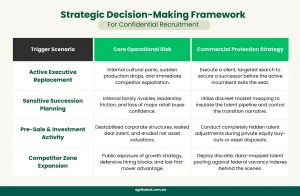
Agribusinesses must utilise a specialised executive search process when open market visibility introduces unacceptable financial and operational risk. For senior agribusiness and FMCG operations, specific organisational milestones demand absolute structural privacy. When a business needs to replace an active, underperforming executive, sourcing a replacement while an incumbent is still in their seat requires complete discretion to avoid internal cultural panic, operational drops, and immediate competitor exploitation.
Similarly, executing a sensitive succession plan by managing generational change within a prominent family-owned pastoral enterprise, or adjusting structures before a formal corporate announcement, keeps internal rivalries at bay and reassures major retail buyers. These high-discretion approaches are also vital during pre-sale reorganisations and investment activity, where preparing a corporate broadacre enterprise or processing facility for an impending private equity buy-out or asset disposal means keeping talent adjustments completely hidden to protect net asset valuations.
When navigating market expansions into competitor zones, matching federal vacancy and employer indices against senior agribusiness operational leadership availability requires discrete, data-mapped talent pooling rather than public exposure. Utilising data from the Jobs and Skills Australia recruitment indexes ultimately prevents public exposure and secures market advantages.
What genuine confidentiality looks like in an executive search process
True confidentiality requires a rigorous operational architecture instead of a simple verbal promise. Experienced FMCG recruitment specialists replace standard public transactional recruiting with a highly disciplined, multi-layered security protocol designed to protect the client’s corporate identity.
- De-identified corporate profiling: The recruiter represents the client’s business using broad industry parameters, production scales, and regional metrics rather than brand names or specific geographic landmarks.
- Multi-stage non-disclosure agreements: Candidates do not learn the identity of the enterprise until the firm thoroughly vets their background, intent, and professional discretion, and legal NDAs are fully executed.
- Ring-fenced data management: High-security confidential executive search for FMCG utilises isolated communication channels and restricted digital folders to ensure no internal staff or external market entities gain unauthorised access to project files.
The commercial risk of a confidential process that leaks
An unmanaged market leak during a senior hiring process carries immediate, measurable financial consequences. In the agricultural sector, where margins are tightly bound to seasonal cycles and strict retail grocery contracts, a sudden rumour of executive instability can cause swift commercial damage across multiple channels. Dedicated Supply Chain Recruitment safeguards must be active to ensure logistical hubs remain completely unimpacted by external speculation.
| Risk Dimension | Operational Impact | Financial Consequence |
| Internal Morale | Key operational staff on stations or processing lines experience anxiety, leading to a drop in productivity or unexpected turnover. | Increased secondary recruitment costs and sudden labour shortfalls during peak operational windows. |
| Supply Chain Integrity | Major retail buyers and supermarket chains lose confidence in the brand’s ability to meet volume requirements and strict delivery timelines. | Potential margin erosion, loss of preferred supplier status, or delayed contract renewals. |
| Investor Confidence | Corporate shareholders and joint-venture partners perceive a governance vacuum or hidden institutional instability. | Fluctuations in asset valuation or delays in securing critical venture capital funding. |
Replacing an underperforming executive: why advertising is never the answer

Using public job boards or open market advertisements to replace an active senior leader is a dangerous strategy that signals corporate vulnerability. According to data tracked in the Australian Industry Group Labour Market Dynamics Report, job turnover has trended systematically lower in real estate services, wholesale trade, and the agriculture, forestry, and fishing sectors. Because executive-level role turnover remains characteristically low within agribusiness executive search environments, publicly flagging a high-level opening risks alarming passive talent who prefer long-term structural stability.
A silent, targeted search allows the board and executive committee to maintain absolute control over the transition timeline. This approach guarantees that daily processing operations, export logistics, and workplace health and safety protocols continue functioning at peak efficiency. It allows the business to safely evaluate elite candidates in the market without triggering an internal crisis or forcing a premature resignation before the successor is fully secured.
Confidential succession: how to recruit a successor without destabilising the business
Managing leadership succession across Broadacre operations or corporate pastoral governance requires an approach that balances family heritage with institutional investor demands. According to the ABARES workforce data on the cattle feedlot sector, a growing feedlot industry plays an important role in smoothing Australian beef production and export availability. For corporate pastoral entities and integrated supply chains, shifting a leadership pipeline must not alter the stability of ongoing broadacre operations, processing schedules, or retail delivery timelines.
Discreet market mapping allows corporate pastoral entities to source and secure high-calibre successors without causing friction among internal candidates or alarming capital partners. When companies execute a confidential executive search, the business insulates its talent pipeline, controls the narrative surrounding generational change, and presents a seamless, highly organised transition to the market when the strategy is fully realised. Establishing a secure pipeline allows businesses to preserve long-term market valuations.
How to evaluate whether a recruitment partner can genuinely protect confidentiality
Not all recruitment agencies possess the infrastructure or industry depth required to execute a high-security executive search. When evaluating how a generalist agency performs compared to specialised FMCG recruitment specialists, senior decision-makers should measure corporate firms against clear, objective operational criteria.
- Dedicated executive infrastructure: The firm must demonstrate a history of operating entirely outside standard, transactional recruiting models by utilising isolated networks and senior advisors who understand the cotton, beef, and grains sectors.
- Strategic industry vocabulary: True specialists speak the language of cold-chain logistics, processing yields, and corporate agricultural compliance, which ensures they can credibly vet candidates without exposing corporate details.
- Verified history of discretion: The partner must provide a transparent, proven methodology for handling blind candidate outreach and multi-stage data security, backed by a clean track record of uncompromised executive transitions.
Managing internal stakeholders during a confidential senior search

The greatest vulnerability in any secure hiring project rarely comes from the outside market; it originates from internal operational leaks. Managing the flow of information inside the organisation requires strict governance and a highly disciplined communication ring. To achieve this, the board should establish a restricted subcommittee to limit all direct communications regarding the confidential executive search to a small group consisting of the Chair, CEO, or Head of People, which keeps general board updates focused entirely on high-level milestones.
Simultaneously, the management team must implement secure information protocols by using separate, non-corporate communication channels and encrypted documentation to ensure internal administrative staff cannot accidentally view sensitive candidate profiles.
Finally, the leadership team needs to prepare an active rumour response strategy by developing a pre-planned internal messaging framework focused on growth and operational continuity, ensuring the business can instantly stabilise morale if an unauthorised leak occurs.
How AgriTalent structures confidential executive search for FMCG and agribusiness clients
AgriTalent delivers an elite, highly secure, confidential executive search model, tailored specifically to the unique realities of the Australian agricultural supply chain. Led by seasoned human resources and industrial relations experts with decades of experience steering Australia’s largest food and fibre exporters, our team views executive recruitment through a strictly commercial lens.
We protect your enterprise by employing database insulation methods, targeted passive candidate networks, and multi-layered de-identification frameworks. We understand that safeguarding your corporate reputation, maintaining operational stability, and protecting investor confidence are just as critical as securing the perfect candidate. Our deep connection to the broadacre farming and FMCG sectors allows us to execute seamless, zero-risk leadership transitions that position your agribusiness directly for long-term growth.
Protecting your operational continuity requires absolute discretion from day one. Discuss your broadacre workforce strategy with our specialist executive search team today for a completely private consultation, or explore our dedicated senior operational leadership search capabilities to safeguard your next leadership transition.
Frequently asked questions
What makes an executive search process genuinely confidential?
Genuinely secure recruitment relies on complete operational isolation rather than simple promises. Professional FMCG recruitment specialists use blind corporate descriptions, withhold brand identities until signing non-disclosure agreements, and use isolated digital files to protect business data.
How do you approach a confidential search for a role where the current incumbent is still employed?
We run the entire project outside standard corporate environments. Our team reaches out directly to passive industry networks outside office hours, handles interviews off-site, and schedules meetings to ensure zero exposure to your staff or the broader market.
Can candidates be approached directly without the search becoming known to the market?
Yes, using targeted market insulation. By working with a specialist agribusiness executive search firm, agents approach candidates using broad industry parameters and skills criteria, keeping your exact company identity completely hidden until candidate intent is verified.
What should we tell the board or leadership team during a confidential senior hire?
Keep the core group small by using a restricted subcommittee structure. Provide the board with high-level timeline milestones and risk assessments, but keep specific candidate names and operational details within a secure communication ring.
How do we handle confidential recruitment when we are a listed company with disclosure obligations?
We coordinate closely with your legal counsel and corporate governance teams to align the search timeline with continuous disclosure requirements. This ensures material changes are structured carefully, allowing candidate mapping to progress discreetly behind the scenes until the regulatory trigger point is reached.
What happens if a confidential search becomes known before we are ready to announce?
A leak requires an immediate, pre-planned communications response. If details escape into the market, you must use clear messaging that focuses on business growth and stability to protect internal morale and reassure external commercial partners.