


Commercial talent is frequently the ultimate constraint on Australian agribusinesses expanding into retail, foodservice, or branded product channels. Operations routinely invest heavily in processing infrastructure, product development, and farm-gate capacity, only to discover their strategic expansion stalls due to severe gaps in market-facing leadership. Engaging FMCG recruitment specialists gives executive leaders a direct strategic lever to convert raw agricultural volume into high-margin retail revenue.
Key Takeaway for Business Leaders:
Generalist agencies lack access to passive metropolitan consumer goods networks and fail to navigate supermarket duopoly dynamics. Specialist FMCG recruiters bridge the gap between regional production and corporate retail, securing market-facing leaders faster, protecting brand margins during category reviews, and safeguarding capital investments.
How Specialist FMCG Recruiters Enable Agribusiness Growth
- Accelerated access to passive metropolitan talent networks to engage top-tier commercial leaders who do not browse public job boards
- Deep structural understanding of the major grocery duopoly to ensure your business successfully navigates high-stakes retail category reviews
- Expert calibration of corporate roles and remuneration structures to align metropolitan candidate expectations with regional business realities
- Significant reduction in hiring risk and vacancy timelines to protect your capital investments and secure critical market listings ahead of competitors
Why commercial talent is the constraint most agribusiness growth plans do not anticipate
Growth plans in the broadacre and livestock sectors typically focus on operational scale, cold-chain infrastructure, and production efficiencies. Boardrooms routinely underestimate the sophisticated consumer-side commercial capability required to protect margins against global price fluctuations and highly consolidated domestic retail environments.
According to the ABARES June 2026 Agricultural Commodities Report, average broadacre farm business profits are set to decline by 70% in 2026–27. This sharp downturn is driven by lower crop and livestock production volumes alongside lower prices received for livestock. Furthermore, the total value of livestock and livestock products is forecast to decline by $1.1 billion to $47.4 billion in 2026–27.
In this tightening macroeconomic environment, traditional bulk commodity production models expose businesses to intense price volatility. True commercial survival and sustainable growth depend on transitioning toward branded, value-added consumer products.
When an enterprise makes this leap, the operational bottleneck shifts directly from production capacity to retail account execution. Lacking experienced corporate consumer goods professionals, major supermarket listings stall, promotional budgets underperform, and wholesale pricing strategies collapse during gruelling retailer category reviews. Securing specialised talent protects margins against intense pressure from major supermarket buyers, directly safeguarding commercial performance early in the expansion cycle.
What a specialist FMCG recruiter brings that a generalist cannot
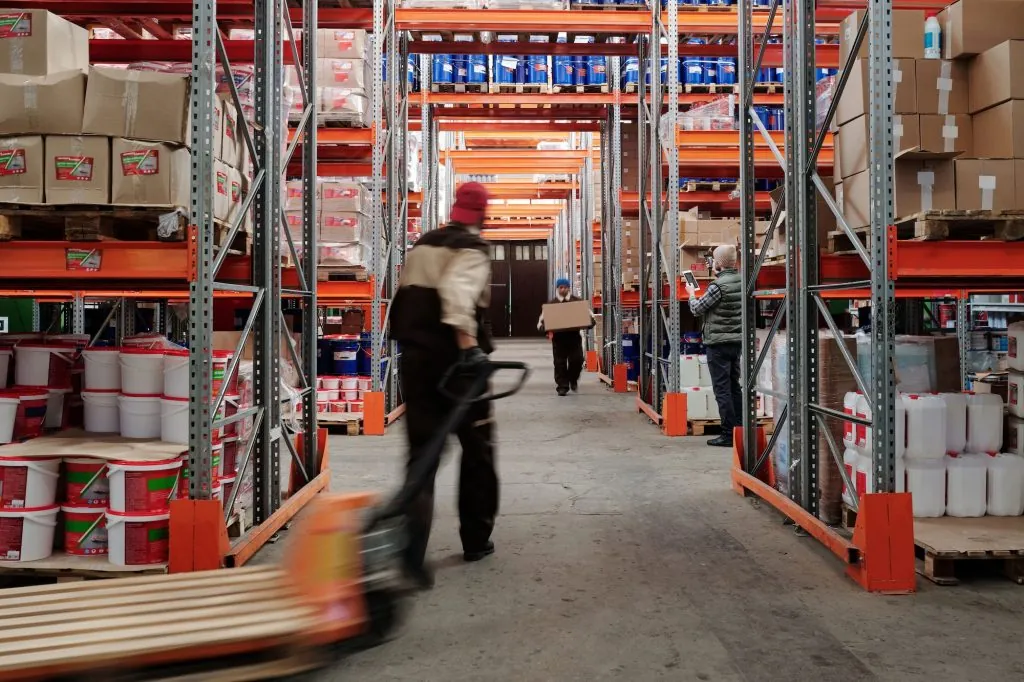
Direct market access and deep sector insight drive the performance gap between generalist agencies and niche specialists. Traditional agricultural recruiters possess exceptional farm-gate networks and agronomic placement histories. However, they lack deep-seated connections within metropolitan corporate headquarters required to source elite consumer-goods talent.
Conversely, generalist corporate recruiters hold high domain authority but lack familiarity with regional logistics, broadacre realities, and the unique cultural friction points that occur when relocating city-based corporate talent into regional agribusiness environments.
To help guide your supplier selection, this framework contrasts the strategic advantages of engaging a specialist partner against standard transactional channels:
| Capability | Generalist Recruitment Agency | Traditional Agribusiness Recruiter | Specialist FMCG Recruiter |
| Primary Talent Network | Broad metropolitan corporate databases (generic administration, finance, generic sales). | Regional farm managers, agronomists, station hands, and operational staff. | Active and passive networks of metropolitan National Account Managers, Category Managers, and Commercial Directors. |
| Retail Ecosystem Knowledge | Minimal understanding of grocery duopoly dynamics or grocery codes. | Deep knowledge of livestock markets and grain trading, weak grocery retail depth. | Thorough understanding of Coles, Woolworths, Aldi, Metcash, and foodservice procurement cycles. |
| Regional Relocation Nuance | Struggles to assess candidate alignment with regional and remote operational realities. | Deeply understands regional life but lacks access to corporate candidates willing to transition. | Bridges the gap by translating the strategic advantages of agribusiness to corporate metropolitan professionals. |
| Commercial Outcomes | High risk of extended placement timelines and misaligned capability. | Strong operational placements but high risk when applied to corporate retail roles. | Accelerated hiring speed, stronger retention, reduced hiring risk, and protected brand margins. |
FMCG recruitment specialists bridge this divide through four distinct pillars:
- Access to deep, passive talent networks:
They maintain active, multi-year relationships with high-performing professionals who do not review public job boards.
- Structural understanding of major retail accounts:
They deeply comprehend the operational mechanics of the corporate grocery duopoly (Coles and Woolworths), Aldi, and major foodservice supply chains.
- Accurate role calibration:
They align commercial expectations between agribusiness employers and corporate-trained candidates, ensuring compensation and KPI structures meet industry standards.
The commercial roles that determine whether an agribusiness growth plan succeeds
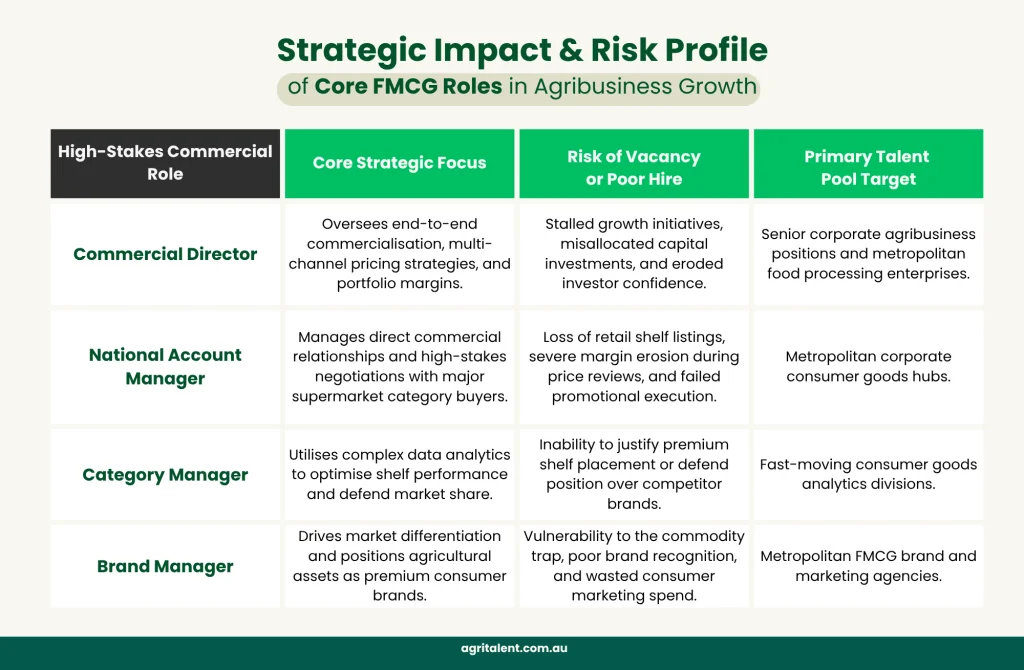
Specific high-stakes corporate roles carry disproportionate commercial risk during a retail expansion strategy. Evaluating the operational reality of each critical position ensures precise candidate alignment during recruitment:
- Commercial Director:
- Serves as the strategic foundation for value-add expansion by governing the commercialisation pathway, setting multi-channel pricing, and maintaining portfolio margins.
- A vacancy in this position frequently leads to stalled growth initiatives, misallocated capital investments, and dropped investor confidence.
- Because candidate pools reside within senior corporate agribusinesses and metropolitan food processing enterprises, businesses should utilise a targeted FMCG executive search for growth to secure elite senior commercial leadership recruitment.
- National Account Manager:
- Protects the daily commercial interface with major supermarket category buyers through direct relationship management and high-stakes negotiation.
- If left unfilled or poorly executed, agribusinesses risk the immediate loss of retail shelf listings, severe margin erosion during price reviews, and failed promotional campaigns.
- Accessing this specific capability requires experienced FMCG recruiters in Australia to effectively engage talent within metropolitan corporate consumer goods hubs.
- Category Manager:
- Functions as the analytical engine of your retail strategy by using data analytics to optimise shelf performance, interpret consumer trends, and secure market share.
- Agribusinesses lacking dedicated category management expertise struggle to justify premium shelf placements or defend their space against agile competitor brands during major category reviews.
- Brand Manager:
- Drives market differentiation by transforming raw agricultural assets into recognised consumer brands and maximising marketing ROI.
- Without this capability, an enterprise remains vulnerable to the standard commodity trap, suffers from poor brand recognition, and risks wasting valuable consumer marketing spend on poorly targeted campaigns.
How specialist market access accelerates growth plan execution
Speed to market is a critical metric during large-scale business expansions. Niche recruiters significantly compress standard hiring timelines by replacing reactive, database-driven workflows with direct, proactive candidate mapping. By maintaining active contact with qualified, non-searching candidate pools, specialists prevent the multi-month delays associated with generic job board postings.
A prolonged leadership vacancy places immense pressure on existing operational teams, reduces market productivity, and increases structural risk. When an agribusiness attempts to navigate corporate grocery supply chains without dedicated commercial advocates, execution milestones stall. Specialised market access ensures that an enterprise engages top-tier talent ahead of peak retail review windows, protecting critical project timelines and delivering actionable commercial talent market intelligence.
The cost of a wrong or slow commercial hire during a growth initiative

The comprehensive cost of a failed or delayed executive hire extends far beyond basic salary expenses because it directly encompasses missed market opportunities and eroded capital. In the context of a major retail expansion, a single misaligned commercial placement can result in immediate, devastating financial consequences.
- Missed category review windows represent a major threat because supermarket networks review categories on strict annual or bi-annual schedules, and missing these specific timelines can delay a product listing by 12 to 24 months.
- Severe margin erosion occurs when inexperienced negotiators yield to aggressive pricing pressure from major retail buyers, permanently damaging farm-gate profitability.
- Diminished investor confidence quickly follows delayed commercial execution, directly threatening overall asset valuations for institutional agricultural investment advisors and pastoral asset managers.
The Jobs and Skills Australia 2026 Workforce Insights report highlights that structural skills shortages across regional industries continue to place operational pressure on corporate supply chains. Similarly, the National Farmers’ Federation (NFF) regional workforce assessments highlight that agriculture faces persistent and acute workforce pressures that must be addressed if the sector is to remain strong, viable, and productive.
These shortages drag down productivity rates, increase costs for farm businesses, and ultimately hamper food supply chains. These structural deficits transform commercial leadership recruitment into a critical risk-mitigation investment. Reviewing the 2026 FMCG talent market outlook reveals that navigating commercial talent trends in agribusiness requires a sophisticated strategy for attracting commercial talent into agribusiness brands.
How to make the case internally for a specialist FMCG recruitment partner
Corporate agribusiness groups and family-owned pastoral operations frequently default to generalist recruitment panels due to procurement-driven supplier selection rules. Senior leaders can shift this internal conversation by presenting the selection of a recruiting partner as a calculated commercial risk mitigation strategy.
When presenting the business case to financial stakeholders or a procurement board, compare long-term revenue protection directly against short-term transactional placement fees. A failed generalist placement or an extended three-month vacancy in a National Account Manager role results in immediate revenue loss on supermarket shelves. A specialised partnership operates as a direct investment that secures market access, protects brand margins, and accelerates the return on capital infrastructure investments.
What to look for when selecting an FMCG recruitment specialist for your growth plan
When evaluating an external workforce advisor to guide your commercial growth strategy, look for specific, proven benchmarks:
- A proven track record in consumer goods requires a demonstrated history of successful placements across food processing, manufacturing, and consumer-facing product sectors.
- Deep understanding of supermarket dynamics means the partner must possess first-hand knowledge of the Australian Food and Grocery Code of Conduct, supermarket category review cycles, and the structural vulnerabilities identified in the NFF supply chain analysis.
- Dual-market positioning ensures the agency understands both the regional agricultural context and the corporate metropolitan talent landscape.
The right recruitment partner must act as a strategic advisor that understands the complexities of national supply chains, agribusiness logistics, and corporate talent alignment as outlined in the Australian Government’s agricultural workforce framework. Accessing comprehensive FMCG agribusiness growth recruitment insights ensures your leadership team can properly source FMCG supply chain talent for growth.
How AgriTalent supports agribusiness growth plans through specialist FMCG recruitment
Successfully bridging the gap between primary production and corporate consumer markets requires a partner that genuinely understands both operating models. A smooth transition from farm-gate production to a corporate grocery boardroom relies on specialised networks that generalist agencies cannot access.
AgriTalent operates at this unique intersection of primary production knowledge and corporate consumer networks. Since 2011, our consultants have been placing high-performing candidates within the fast-moving consumer goods sector. We adapt continuously to an industry that is highly automated, hygienic, and target-driven. We provide unmatched access to an extensive national database of commercial and supply chain talent, helping businesses transition smoothly from a commodity focus to a branded retail model.
Our specialised candidate assessment method looks beyond basic resumes to evaluate problem-solving capabilities, technical skills, and cultural alignment. Whether your enterprise requires elite FMCG recruitment specialists to manage supermarket accounts, advanced agribusiness commercial and supply chain leadership to streamline logistics, or dedicated commercial talent acquisition, AgriTalent delivers candidates who understand both the farm-gate reality and the corporate boardroom.
Conclusion
Agribusiness growth across Australia faces structural constraints stemming primarily from commercial capability limitations rather than standard production volumes. To secure your market expansion goals and defend farm-gate profitability against shifting macroeconomic pressures, your talent strategy must align with your corporate ambition. Partnering with a dedicated specialist ensures your management team possesses the exact commercial expertise required to turn production capacity into sustainable corporate revenue, reducing hiring risk while accelerating your time to market.
Ensure your management team possesses the exact commercial expertise required to turn production capacity into sustainable corporate revenue. Discuss your broadacre workforce strategy with our senior recruitment advisors today.
Frequently asked questions
Why do agribusiness growth plans stall at the commercial talent stage?
Many Australian agribusiness initiatives focus heavily on scaling primary production and upgrading processing infrastructure. However, leadership teams frequently underestimate the highly specialised commercial expertise required to navigate corporate grocery environments and retail brand channels. Without experienced specialists like National Account Managers, businesses struggle to convert raw processing capabilities into profitable long-term supply arrangements.
Which FMCG commercial roles should an agribusiness prioritise when entering retail or foodservice?
Agribusinesses moving towards consumer-facing channels should prioritise securing a Commercial Director to guide high-level pricing strategy, a National Account Manager to manage direct relationships with major supermarket buyers, and a Category Manager to interpret market data. Securing this commercial talent and market intelligence ensures protection for your margins and keeps your product lines aligned with retail demand.
How quickly can a specialist FMCG recruiter fill a senior commercial role compared to a generalist?
Partnering with experienced FMCG recruiters in Australia typically reduces standard hiring timelines by several weeks while significantly improving shortlist quality. While generalist agencies rely on public job board postings, niche specialists maintain established, direct relationships with passive candidates, accelerating access to top-tier commercial talent and protecting your expansion milestones from prolonged vacancies.
What does a specialist FMCG recruiter actually do differently in the search process?
Specialised recruiters rely on direct candidate engagement and deep industry insight rather than administrative, database-driven workflows. They actively map competitive corporate spaces, evaluate candidates using specific retail benchmarks, and translate the strategic advantages of agribusiness positions to metropolitan professionals, ensuring candidates possess both technical capability and alignment with your business culture.
How do we justify the cost of a specialist FMCG recruiter versus a cheaper generalist option?
The financial investment required for a specialised recruitment strategy should be evaluated against the potential commercial losses associated with an extended vacancy or a poor hiring decision. In the context of a major retail expansion, a single failed hire can result in missed shelf space allocations, poor promotional strategies, and eroded wholesale margins. Viewing specialised recruitment as an essential risk-mitigation tool helps protect long-term revenue targets.
Can AgriTalent recruit FMCG commercial roles for businesses outside traditional primary production?
Yes. AgriTalent operates across the entire intersection of agribusiness, food production, and FMCG. We support enterprises involved in processing and manufacturing, branded consumer products, and retail or export supply chains, providing the cross-sector capability required to successfully place high-level commercial talent into diverse agribusiness environments.