


The effective management of a modern agricultural enterprise requires clear commercial foresight and structural resilience. Proactive cotton industry recruitment Australia is increasingly the critical mechanism that determines whether leadership successions protect enterprise value or trigger operational decline. Across cotton farming and ginning operations, owners frequently treat succession purely as a financial or legal transfer, when in reality it represents a profound talent acquisition and capability challenge that directly impacts investor confidence and seasonal profitability.
According to data from Jobs and Skills Australia, regional areas present distinct structural employment trends that heavily impact how agricultural businesses maintain continuity. Without proactive recruitment embedded into succession planning, even well-structured transition strategies struggle to materialise on the ground. The long-term commercial survival of an enterprise relies on having qualified hands ready to manage volatile input margins, complex water portfolios, and the unique operational demands of broadacre production.
When a business relies on a small number of individuals to hold all localized operational knowledge, it creates an immediate vulnerability. Spreading that capability across a structured talent pipeline ensures that the commercial viability of the farm is preserved for the next generation, safeguarding production outcomes from unexpected leadership gaps.
Why succession planning is a recruitment problem, not just a legal or financial one
Many broadacre businesses treat future planning as an accounting exercise. Succession plans often focus on:
- The legal transfer of land and entity ownership
- The minimisation of family tax liabilities over time
- The structural governance of the family trust or corporate board
However, these legal frameworks become irrelevant if the business lacks capable leadership to execute daily operations. A business can possess pristine financial books, but it will face rapid operational failure if there is no executive leader to manage daily irrigation schedules, volatile input costs, and complex staff dynamics. True operational resilience requires a clear strategy for human capital.
In practice, succession depends on:
- The development of high-level leadership capability within the existing management team.
- The preservation of deep operational knowledge regarding specific land assets, soil profiles, and water infrastructure.
- The maintenance of workforce continuity across highly volatile production seasons.
This is where strategic cotton industry recruitment becomes critical, ensuring the right people are identified, developed, or secured externally. True succession planning cannot happen in a vacuum. It must be paired with active talent sourcing to replace departing leaders with skilled personnel who understand modern agronomy and margin management, making the transition an asset-building exercise rather than an operational risk.
The succession risk profile of the Australian cotton industry
The broadacre sector is navigating a significant demographic shift that directly threatens business continuity. The Australian cotton sector faces a unique convergence of risks:
- An ageing leadership profile across farming and ginning operations.
- A limited pipeline of experienced mid-level managers ready to step up
- Increasing operational complexity driven by water compliance and precision technology
- Persistent regional workforce constraints that thin out local talent pools
These factors make strategic cotton industry recruitment and comprehensive cotton industry skills and workforce planning a top priority for corporate boards and family owners alike. Business owners cannot assume that the next generation or local market will naturally fill leadership gaps when an experienced manager departs.
Jobs and Skills Australia reports acute skill shortages across remote supply chains, which highlights the difficulty of finding specialised agricultural professionals in isolated regions. Cotton Australia summaries emphasize how the changing nature of farming impacts the workforce, pointing to a rising skills bar with the increasing integration of technology in all operational areas. As the average age of agricultural managers continues to sit well above other industries, the timeline to address these gaps is shrinking, increasing succession risk for unprepared operations.
The integration of advanced systems requires a different type of leader than in previous decades. Modern operations need managers who understand data analytics, automated water infrastructure, and carbon compliance. This rising skill level makes finding a suitable successor a complex recruitment challenge rather than a simple hand-over.
The roles with the highest succession risk in cotton farming and ginning

Certain positions carry a disproportionate amount of operational risk if they remain vacant. High-risk roles include:
- Farm Managers and Property Operations Directors
- Irrigation Specialists and Water Infrastructure Managers
- Ginning Managers and Plant Operations Leaders
- Maintenance Engineers and Heavy Machinery Technicians
- Senior Agronomists and Crop Production Consultants
In ginning environments, cotton gin recruitment in Australia is particularly challenging due to:
- Highly specific technical skill requirements for ginning machinery
- Intense seasonal production schedules that demand long hours
- Regional location constraints that limit the local applicant pool
When a senior farm manager leaves without a clear replacement, the entire production schedule faces disruption. Securing top candidates for cotton farming jobs Australia requires a deep blend of practical agronomy and corporate asset management, making these professionals exceptionally hard to replace in a hurry. Proactive planning helps mitigate the sudden loss of this localized expertise.
Irrigation managers hold the key to yield consistency through precise water application. A failure to smoothly transition this role can lead to costly mistakes in water budgeting and crop health across a season. Securing this technical capability requires targeted talent strategies.
Ginning operations face intense pressure during the harvest window, where down-time costs thousands of dollars per hour. If maintenance and engineering leadership positions are left unfilled, the operational throughput of the entire facility is placed at risk. Proactive sourcing ensures these technical roles are stabilized long before the season commences, safeguarding commercial returns during peak processing windows.
When to start recruitment as part of a cotton industry succession plan
To wait for an active retirement or departure to begin searching for a replacement is a costly mistake that introduces significant succession risk. Most businesses start too late. When an unexpected vacancy occurs in a critical role, the business is forced into reactive hiring, which often results in compromised talent selection, operational delays, and inflated salary costs.
Best practice dictates a structured timeline:
- Identify succession-critical roles 3–5 years in advance of an expected transition
- Begin internal development pathways early to prepare existing staff
- Engage external recruitment channels before the transition becomes urgent
Early-stage cotton industry recruitment Australia allows:
- A wider selection of high-quality candidates from across the market
- A structured period of overlap for effective knowledge transfer
- Reduced operational disruption during the official leadership hand-over
Integrating a detailed timeline into your broader cotton workforce planning protects the business from sudden vacancies. This window gives the incoming leader ample time to understand the unique soil types, local water delivery systems, and community networks necessary to run the enterprise efficiently, ensuring that expansion capability and production metrics remain unaffected.
Internal development versus external recruitment in cotton succession planning
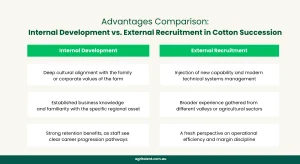
A resilient business model balances the cultivation of existing staff with the strategic acquisition of external talent. Broadacre succession planning and recruitment requires a balanced approach that weights the commercial realities, financial investments, and operational timelines of both pathways.
To assist enterprise leaders in navigating this pivotal choice, the strategic framework below outlines the distinct trade-offs inherent in each approach:
Maximising the value of internal pathways
When an enterprise opts for internal development, the commercial focus is asset protection and continuity.
- Knowledge Preservation: Senior farm managers and water specialists accumulate decades of asset-specific intelligence regarding localized soil performance, complex water delivery networks, and community dynamics.
- Cultural Security: Promoting from within rewards loyalty and stabilizes the broader workforce, which shields the business from the cultural disruption that can occur when an outsider takes the helm.
- Addressing the Limitations: To prevent the duplication of historical process inefficiencies highlighted in the framework, operations must invest in formal external professional development. This ensures internal candidates gain exposure to modern agtech, corporate governance, and advanced margin-management strategies before stepping into executive roles.
Executing strategic external sourcing
When the internal talent pool is restricted by the reality of thin regional markets, external recruitment becomes the primary mechanism to drive enterprise growth.
- Injecting Innovation: Bringing in leaders from different geographical regions or corporate broadacre backgrounds introduces sophisticated production models, advanced data analytics capabilities, and rigorous compliance methodologies.
- Mitigating the Capital Risk: While the framework notes that external placement requires a higher upfront financial investment, this cost is offset by the speed at which a highly qualified specialist can address critical technical or structural gaps.
- Managing the Transition: To smooth the longer cultural adaptation periods, businesses must design a structured, multi-month handover window. This overlap allows the incoming executive to absorb localized operational knowledge while establishing vital relationships with local agronomists, ginning plant operators, and suppliers.
Ultimately, effective cotton industry recruitment strategies combine both approaches rather than viewing them as mutually exclusive options. If internal candidates lack the commercial readiness to immediately take over, looking to the wider market ensures the business maintains its production momentum. Partnering with a specialist agribusiness advisor allows leaders to benchmark internal talent against the best available professionals in the country, turning a potential succession vulnerability into a secure, long-term commercial advantage.
The regional talent problem: why succession is harder in cotton-growing communities
The geographic concentration of broadacre operations introduces structural recruitment hurdles that urban businesses rarely encounter. Cotton operations are concentrated in regional NSW and Queensland, creating:
- Extremely limited local candidate pools for senior leadership roles
- Significant relocation resistance from metropolitan or coastal professionals
- Intense competition between local agricultural employers for a small pool of workers
This makes cotton industry recruitment Australia highly competitive, particularly for senior roles. Securing a manager involves convincing an entire family to relocate to a regional area, which introduces secondary challenges around partner employment and local schooling options.
Employers who succeed in this landscape:
- Address regional relocation proactively by offering high-quality housing and vehicle benefits
- Offer clear career pathways that promise long-term financial security
- Position roles beyond just location, emphasising the scale and technological sophistication of the asset
To overcome these thin regional markets, operations must widen their geographic search parameters. Securing a reliable NSW cotton farming leadership pipeline or a cotton industry succession recruitment Queensland network is essential when local advertising fails to yield experienced applicants. Secure talent pipelines rely on continuous market engagement.
What succession-linked recruitment looks like in practice
Transitioning a business from one leadership generation to the next requires systematic execution rather than guesswork. Proactive recruitment involves:
- Mapping internal talent against the long-term strategic goals of the enterprise
- Identifying specific capability gaps in the current workforce structure
- Running targeted executive search processes to secure high-level leaders discretely
- Structuring transition timelines that allow outgoing and incoming staff to collaborate
This approach ensures succession plans are executable, not theoretical. It turns a static legal document into an active management strategy.
By utilising executive search for cotton industry succession roles, boards and owners can discretely engage senior managers who are not actively browsing job boards. This deliberate methodology focuses on aligning a candidate’s historical performance with the future commercial objectives of the cotton enterprise, thereby protecting asset valuation and maintaining operational performance throughout the transition.
The commercial cost of succession failure in a cotton enterprise
The absence of a structured leadership transition plan introduces immediate financial liabilities to broadacre operations. Agricultural enterprises must manage leadership transitions with absolute precision because a failure to plan results in steep financial consequences:
- Production inefficiencies due to delayed or poor agronomic decision-making
- Increased operational costs from reactive, short-term labor placements
- A permanent loss of localised operational knowledge and land management history
- Reduced investor and bank confidence in the long-term stability of the farm
In large-scale operations, this can translate into significant financial loss across seasons. A single poorly managed water allocation or an extended delay during the ginning window can erase an entire year’s profit margin.
When a leadership vacancy persists, the burden falls on the remaining operational staff. Without structured agribusiness succession planning, this added stress frequently triggers secondary departures, compounding the labor shortage and destabilising the workplace culture. A business cannot maintain high performance when its key personnel are experiencing burnout.
Furthermore, institutional investors and financial partners scrutinise leadership depth when assessing capital allocations. A farm that relies entirely on the health and presence of a single owner represents a high credit risk. Building a visible leadership transition in family farming businesses through professional talent pipelines reinforces corporate stability, satisfies governance standards, and protects long-term commercial returns.
How to start: a practical framework for cotton industry succession and recruitment

A strong transition pathway requires a step-by-step framework that connects talent acquisition directly to business goals. A reliable operational framework includes:
- Identify Critical Roles
Immediate Priority.
Detail every position that would cause an operational standstill or a drop in yield if left vacant for more than a month, focusing heavily on irrigation and gin management.
- Assess Internal Capability
Months 1-2
Conduct objective performance reviews to see if current staff have the desire and capacity to step up, mapping their current skills against executive requirements.
- Define Future Skill Requirements
Months 2-3.
Outline the technological and commercial skills the business will need over the next five years, focusing on data analytics, carbon compliance, and precision water systems.
- Engage External Sourcing Pathways:
Continuous Planning.
Initiate targeted searches early through specialist cotton industry recruitment networks to fill identified gaps before an active departure occurs.
- Build Transition Timelines:
6-12 Month Overlap.
Design a structured handover period that allows for complete knowledge transfer regarding water assets, soil profiles, and local operations.
By aligning this process with 2026 agribusiness workforce trends, talent acquisition becomes a continuous strategy rather than an emergency response. This methodology ensures that when ownership or management changes hands, production momentum is completely unaffected by changes in the cotton industry hiring outlook.
Conclusion
Succession planning in cotton is ultimately a talent challenge. True business continuity cannot be achieved through legal structures alone; it requires capable people ready to manage complex production variables on the ground.
Proactive cotton industry recruitment in Australia is the mechanism that ensures leadership continuity, protects operational performance, and enables long-term business sustainability. Transitioning an enterprise smoothly requires a proactive look at the entire workforce pipeline.
Engaging with experienced cotton industry leadership recruitment partners ensures your business remains resilient across every upcoming season. Discuss your broadacre workforce strategy with our executive search team to secure your leadership pipeline.
Frequently Asked Questions
How far in advance should a cotton farming business start recruiting for succession-critical roles?
A broadacre enterprise should initiate recruitment and talent mapping three to five years before an anticipated leadership transition. This extended window accounts for the thin regional candidate pool and allows ample time for a thorough hand-over period. Starting early prevents the operational disruptions associated with rushed, reactive hiring.
Is executive search the right model for cotton industry succession roles?
Yes, using executive search for cotton industry succession roles is the most effective model for securing senior operational leaders and specialised ginning management. This method allows businesses to target high-performing professionals who are not actively seeking employment, ensuring a higher standard of talent. It provides the discretion and thorough vetting required for multi-million dollar corporate assets.
How do we identify and develop internal succession candidates in a cotton operation?
Internal candidates are identified through objective performance assessments, leadership capability mapping, and structured skill gap analyses. Once selected, they should be taken through formal professional development pathways and given supervised responsibility over key operational decisions. This hands-on commercial experience prepares them to step into senior roles seamlessly.
What happens if our succession candidate leaves before the transition is complete?
If a designated successor departs unexpectedly, it highlights the importance of maintaining a continuous external talent pipeline. Businesses should never rely solely on a single internal individual without understanding the broader recruitment market. Partnering with an agribusiness recruitment specialist ensures you can quickly pivot to external sourcing options without losing production momentum.
How do we attract external candidates to a regional cotton farming role at a senior level?
Attracting top-tier talent to regional areas requires a compelling employment value proposition that includes competitive remuneration, high-quality housing, and clear paths to business equity or professional progression. Employers must address family relocation needs, such as partner employment and schooling, directly within the offer. Highlighting the scale and technological sophistication of the broadacre asset also draws ambitious professionals.
What is the difference between a succession plan and a workforce plan?
A succession plan focuses specifically on the long-term continuity of leadership and asset ownership across key executive roles. In contrast, a cotton workforce planning strategy addresses the immediate and seasonal staffing requirements across all levels of the operation, including general farm hands and seasonal ginning crews. Both strategies must align to ensure the business has the physical capacity to meet its production targets.