

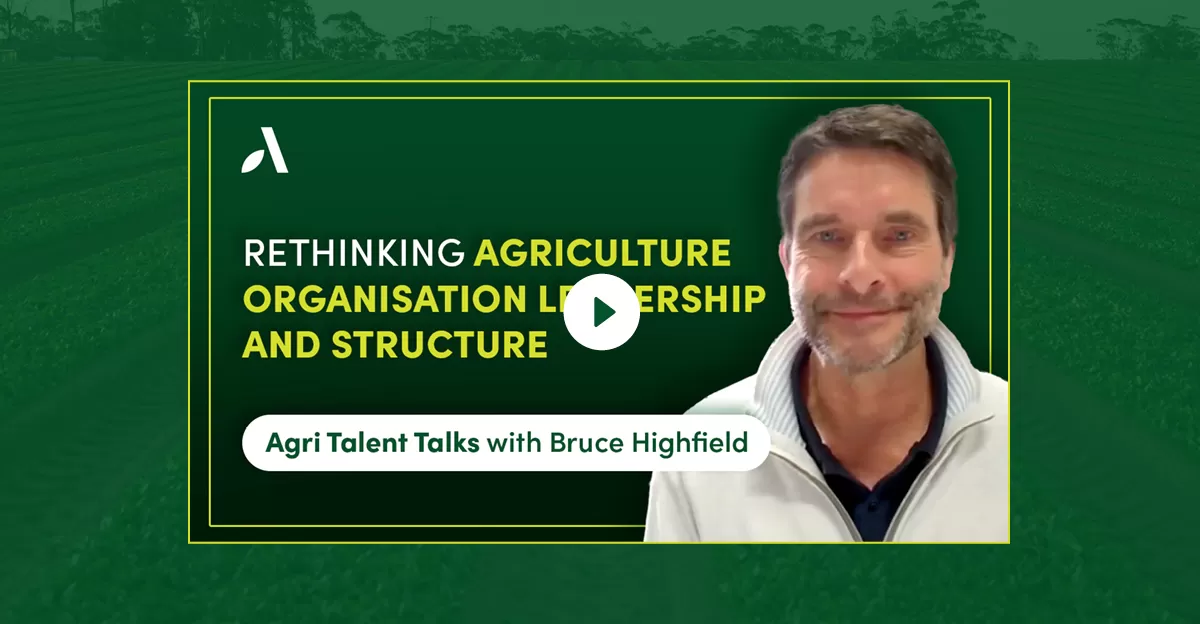
Agri Talent Talks is back – this time featuring insights from Bruce Highfield, Executive Search Lead at Agri Talent, and Managing Director Kelli McDougall.
Drawing on deep expertise in recruitment, leadership and strategic transformation, they explore how the expectations, attributes and structure of agribusiness executive teams are rapidly changing – and what businesses need to do next.
A more complex executive search landscape
Over the past 15 years, the executive landscape in agriculture has become vastly more complex. Where agribusiness was once a relatively insular space, the influx of private equity, global investors and superannuation funds has created new ownership models and heightened expectations. Roles that were once operational now require greater strategic capability, cross-functional leadership and the ability to work within increasingly bureaucratic structures. Despite this complexity, one truth remains constant – executive leaders must still deliver results.
Capability, not just credentials
In today’s environment, past performance is no longer a reliable predictor of future success. Executives are expected to demonstrate learning agility – the ability to continuously evolve their thinking, apply new insights and lead through ambiguity. Kelli explains that too often, businesses have defaulted to hiring based on a traditional notion of success –the impressive CV and familiar pedigree. But in a market this fast-moving, agility and cohesion are proving to be stronger indicators of performance.
Within this addition of Agri Talent Talks, Bruce succinctly described this need for alignment within agribusinesses – “Portability of performance isn’t what we thought. The leaders who succeed today are those with the agility to learn, adapt and keep their organisations moving.”
Cohesion is a theme both Bruce and Kelli return to throughout the conversation.
Cohesive executive teams – where members understand each other’s roles, communicate well and are aligned around shared goals – consistently outperform fragmented groups of high-profile hires.
The succession shortfall Australian agriculture can’t ignore
A particularly pressing issue in the current executive landscape is the lack of clear succession planning. Kelli points to the impact of corporatisation, noting that in the shift from family-owned operations to large-scale corporates, many businesses have failed to build internal leadership capability. The result is a shrinking talent pool for executive roles, with few ready-now leaders being developed from within.
As summated by Kelli during the conversation –“We’re seeing a real shortage of up-and-coming executives. Leaders today need more than strategy — they must build capability underneath them, or the talent gap will only widen.”
This gap is creating added pressure on executive appointments. Leaders today must not only be strategic operators but also team-builders – capable of mentoring, coaching and strengthening the organisation beneath them. It’s a vital step if agribusiness is to avoid the same long-term leadership vacuum seen in trades and other technical sectors.
Boards under pressure to adapt
Beyond the executive layer, the expectations of boards are also shifting. According to Bruce, many organisations are moving away from risk-focused governance and instead looking to appoint directors who can meaningfully support the CEO in developing strategy. With sectors such as AI, data and automation reshaping ag, board composition must now reflect operational insight, not just financial or legal acumen. As Kelli points out, agility isn’t just a trait for management – boards need it too.
Getting back to core business
Ultimately, both Bruce and Kelli agree that many agribusinesses have strayed too far from their core. Executive teams are often overloaded with functional roles while underinvesting in operational leadership. But profitability in agriculture, Bruce stresses, still hinges on quality produce. You can’t fix yield issues in the pack shed – the work must start in the paddock.
That’s why future-focused executive recruitment must put core business understanding back at the centre. Leaders who deeply understand the nuances of growing, harvesting and meeting market requirements will always be best placed to deliver returns.
Shaping the next era of leadership in Australian agriculture
For agribusinesses, the imperative is clear – hire leaders who bring capability, agility and cohesion, not just a track record. Understand the work that needs to be done and the outcomes each executive must deliver. And perhaps most importantly, invest in the next generation. Because without strong internal succession, the leadership gap will only widen.
Looking to strengthen your executive team? Agri Talent can help you find leaders who don’t just fit the role – they transform it.