


The physical scale of Australian agriculture is expanding rapidly, with the gross value of production reaching $100.3 billion recently. According to the official Australian agricultural sector production and export statistics, this massive growth highlights the critical need for advanced corporate talent. Professional FMCG recruiters Australia are at the centre of a growing structural challenge for agribusiness brands. These enterprises must compete directly for commercial talent against larger, more established consumer goods corporations. As agribusinesses move into branded products, retail, and foodservice, long-term commercial success depends entirely on securing the right commercial capability.
The establishment of a high-performing growth team requires a clear shift from traditional agricultural frameworks to modern retail frameworks. Many pastoral companies and processing businesses scale up physical production but struggle to find matching sales professionals. Securing consumer market share requires the same structural discipline as managing logistics or farm gates. Agribusiness leaders can close this commercial skills gap by understanding the motivations of consumer goods professionals. This strategy helps businesses protect their retail margins while expanding their market footprint.
Why agribusiness brands struggle to attract commercial FMCG talent
The acquisition of strategic market presence requires a deep understanding of neutral government figures. The national agricultural employment data confirms that the broadacre sheep, beef cattle, and grain farming sector stands as Australia’s largest agricultural employer with over 121,100 workers. Despite this large operational employment footprint, traditional primary production brands face significant hurdles when seeking corporate professionals. Common barriers include:
- Lower brand recognition among metropolitan professionals.
- Perceived limited career pathways within traditional farming structures.
- Regional locations that require relocation or extensive travel.
- Misaligned role expectations between corporate environments and agricultural supply chains.
The failure to address these issues directly exposes even highly profitable businesses to prolonged recruitment timelines and heightened expansion risk. Many candidates view agricultural corporations as pure commodities businesses instead of consumer brands. This perception hides the advanced commercial opportunities available within vertically integrated supply chains. Corporate professionals often worry about a lack of analytical tools, marketing support, or structured promotional pathways. Agribusiness leaders can overcome these hurdles by changing their market narrative. Showing candidates how agricultural operations connect with consumer tables proves that these roles match any major corporate position.
The commercial consequences: expansion risk and margin pressure
The decision to scale an agribusiness into retail or foodservice channels brings immediate exposure to severe commercial consequences if the commercial team lacks elite training. Agribusiness leaders often underestimate the margin pressure applied by major grocery buyers. An amateur commercial function creates profound organizational exposure, which directly impacts investor confidence and long-term viability.
A weak commercial team slows retail expansion and exposes the brand to aggressive margin pressure from major retail buyers. For instance, an inexperienced account manager might accept poor promotion terms that erase supply profits entirely. The financial cost of a vacant or poorly filled commercial leadership seat frequently manifests as lost supermarket range placements, weak trade spend efficiency, and failed product launches. Hiring trained professionals keeps your business competitive when negotiating with sophisticated retail buyers.
The strategic workforce framework
To support corporate decision-makers, this framework outlines the commercial indicators, business risks, and specific talent solutions required when scaling an agribusiness brand.
| Commercial Growth Indicator | Core Business Risk | Targeted Talent Solution |
| New Retail Channel Entry | Expansion risk, slow speed-to-market, and poor broker management | Appoint an experienced National Account Manager via FMCG recruitment specialists |
| Supermarket Margin Compression | Margin pressure, high trade spend, and unprofitable promotional programs | Recruit a data-driven Category Manager to leverage consumer analytics |
| Brand Differentiation Deficit | Commodity pricing vulnerability and weak consumer brand equity | Hire a Brand Manager with proven product launch experience |
| Inconsistent Scale Strategy | Succession risk, fragmented supply chains, and low investor confidence | Secure a Commercial Director through targeted executive search |
Understanding the regional reality against metropolitan FMCG employers
The geographical tension between regional agricultural production and metropolitan FMCG corporate hubs presents a practical challenge for talent acquisition. Metropolitan fast-moving consumer goods employers hold an advantage in proximity, lifestyle marketing, and established corporate ecosystems. Agribusiness brands often lose prime candidates simply because corporate professionals hesitate to uproot their families from capital cities to relocate to regional processing facilities or pastoral headquarters.
Agribusiness leaders must confront this regional reality with strategic flexibility rather than dismissing the challenge. Successful brands overcome the geographical divide by designing hybrid working models, establishing satellite commercial offices in metropolitan centres, and emphasizing the sheer scale of commercial autonomy available. Professionals in agribusiness often control the entire supply chain from paddock to plate, a level of corporate influence that rarely exists within the highly siloed structures of global metropolitan consumer brands.
The commercial roles that make or break an agribusiness brand in retail and foodservice

The execution of plans to expand into major grocery channels brings strict operational rules. The Australian Food and Grocery Council notes that the sector contributes $172.7 billion to the national economy. This high-volume environment requires specific management skills. Partnering with FMCG recruitment specialists allows agricultural brands to secure professionals who understand these strict requirements. Critical commercial roles include:
- National Account Managers: These specialists manage relationships with major supermarket chains, negotiate trade terms, and secure shelf space.
- Category Managers: These professionals use data to review market share, manage product ranges, and build evidence-based sales strategies.
- Brand Managers: These experts manage consumer messaging, product positioning, and marketing campaigns across retail networks.
- Commercial Directors: These senior executives lead the wider sales, marketing, and supply chain teams to drive long-term business growth.
What FMCG commercial candidates are actually looking for in an employer
Corporate professionals operate in a highly regulated commercial environment. The Australian Competition and Consumer Commission enforces the mandatory Food and Grocery Code of Conduct to manage supermarket relationships. Candidates look for employers who understand these retail legalities and operational structures. Professionals prioritise several core elements, including:
- Clear career progression and professional development opportunities.
- Brand strength and a commitment to market innovation.
- Leadership quality that values data-driven commercial decisions.
- Commercial autonomy to manage accounts and execute retail strategies.
The alignment of your business with these expectations is essential to compete effectively. Corporate professionals rarely move for simple salary increases alone. They look for organisations that provide clear commercial pathways and modern analytical tools. Businesses win these candidates by offering real responsibility over emerging brands or new market channels. Showing a commitment to corporate governance and strategic market growth builds candidate trust from the first interview.
How to position your agribusiness brand as a compelling employer for FMCG talent
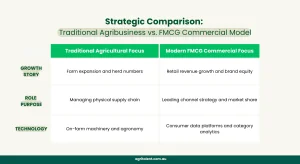
The acquisition of corporate candidates requires agricultural brands to change their recruitment marketing fundamentally. Working closely with FMCG recruitment specialists helps businesses design messages that connect with metropolitan sales professionals.
Successful strategies include highlighting the growth trajectory of your branded retail products, emphasising the level of impact and professional autonomy available in the role, and showcasing leadership capability alongside corporate governance structures.
This clear focus shifts candidate perception from a small regional player to a high-growth business opportunity. Corporate professionals often feel restricted by the rigid structures of global consumer goods corporations. Agribusinesses can position themselves as entrepreneurial alternatives where commercial decisions happen fast. Showing how a role influences the entire supply chain creates a compelling offer for ambitious sales leaders.
Remuneration reality: What agribusiness brands need to offer to compete
The retention of premium commercial specialists requires realistic market packages. The Department of Health and Aged Care highlights that Australia maintains strict regulations under the Food Standards Code. Managing these multi-million dollar portfolios and food safety risks requires high-level corporate expertise. Agribusiness leaders can review the latest analysis on salary benchmarks and hiring data in the agricultural sector to understand current expectations across the sector.
While agricultural enterprises might not always match the baseline salaries of multi-national consumer businesses, they compete effectively through:
- Performance-based incentive structures tied to clear retail growth.
- Accelerated career growth pathways within expanding businesses.
- Broader role scopes that provide diverse corporate exposure.
Experienced FMCG recruiters Australia help brands build creative, attractive packages. Base salaries must stay competitive with metropolitan markets, but performance bonuses can reward market share gains. Additional benefits like flexible hybrid work options help overcome regional location hurdles. Framing total remuneration around business growth turns labour costs into a strategic investment in retail profitability.
The hidden advantage agribusiness brands have in the FMCG talent market
Agribusinesses possess unique operational qualities that appeal to corporate professionals. Partnering with FMCG recruitment specialists allows primary producers to showcase these unique workplace benefits. Real business advantages include faster decision-making lines that avoid global corporate delays, broader role exposure across the entire supply chain, and a stronger personal impact on final business performance and product strategy.
These factors attract high-performing professionals who feel limited by corporate bureaucracy. Many corporate account managers prefer working where they can speak directly with company founders and managing directors. Agribusinesses offer a clear connection to authentic food production and sustainable farming practices. This genuine focus appeals to professionals seeking meaningful corporate work. Emphasising these cultural strengths helps agricultural brands win talent over larger competitors.
How specialist FMCG recruiters access talent that job boards cannot reach

The use of active job boards rarely attracts high-performing commercial leaders. Many top-tier managers remain employed and focus on their current retail portfolios. Securing these professionals requires a strategic approach. Utilising a discreet headhunting service for C-suite and senior agricultural roles allows businesses to connect with these passive candidates confidentially.
Experienced FMCG recruiters Australia deliver value by:
- Engaging passive candidates through established corporate networks.
- Targeting competitor markets to find proven sales specialists.
- Positioning agricultural roles as valuable career milestones.
This targeted method unlocks talent pools that standard advertisements miss entirely. Recruitment specialists understand how to represent your business professionally to high-level corporate candidates. They manage the initial outreach, handle salary expectations, and position the opportunity around the candidate’s career goals. This strategic management reduces hiring risks and ensures a strong fit for your growth team.
Building a commercial talent pipeline as your agribusiness brand scales
The maintenance of long-term retail growth requires a proactive talent strategy. Agribusinesses must view commercial capability as a permanent asset rather than a quick fix for empty chairs. Forward-thinking businesses use clear processes, such as building relationships with corporate professionals early, well before vacancies open. Investing in long-term employer branding that showcases commercial success and using proactive recruitment strategies to find future leaders ahead of time are equally vital.
A structured talent pipeline prevents empty leadership spots from stalling your retail strategies. As your branded products enter new supermarket networks, your human resources must scale to support that growth. If you are ready to proactively secure high-performing professionals, you can discuss your FMCG commercial hiring strategy with our agricultural workforce experts to plan your leadership succession pipeline. This ongoing strategy provides the talent security required to win market share and build a highly profitable consumer brand.
Conclusion
Successful commercial competition within the space of FMCG recruiters in Australia requires strategic brand positioning, clear corporate value propositions, and direct access to established professional networks. Agribusinesses that treat sales acquisition as a reactive task remain exposed to prolonged operational vacancies and lost retail revenue. Conversely, forward-thinking broadacre enterprises secure a distinct market position by highlighting their unique supply-chain autonomy.
To protect retail margins and successfully enter new consumer channels, primary producers must build dedicated commercial capabilities. Designing structured development tracks and implementing data-focused performance structures helps brands draw high-performing managers away from metropolitan corporations. Discuss your broadacre workforce strategy today to build a sophisticated commercial team that supports your long-term growth ambitions.
Frequently asked questions
Why do FMCG commercial candidates often overlook agribusiness brands?
Corporate candidates frequently overlook agricultural businesses due to low brand awareness and perceived limitations in career progression. They often view agribusiness as a pure commodities sector rather than a fast-moving consumer brand environment. Addressing this hurdle requires changing your employer branding to highlight your retail channels, data systems, and growth strategies.
Which commercial roles should an agribusiness brand prioritise when entering retail or foodservice?
An expanding agribusiness should prioritise National Account Managers and Commercial Directors to lead initial market entry strategies. These professionals possess the direct relationships and negotiation experience required to secure shelf space with major supermarket chains. Securing this corporate capability early protects gross margins and ensures compliance with grocery industry standards.
How do we compete on salary with larger FMCG businesses when recruiting commercial talent?
Agribusinesses compete effectively by combining competitive base salaries with performance-based incentive structures tied directly to channel revenue. Offering rapid career progression and broad operational autonomy also appeals to professionals feeling restricted by global corporate structures. Flexible hybrid work arrangements further help brands overcome regional location hurdles.
Can we attract FMCG-trained National Account Managers or Category Managers into an agribusiness brand?
Yes, agribusinesses attract top consumer goods professionals by offering direct access to decision-makers and complete ownership of retail strategies. Many experienced managers look for organisations where they can make a visible impact away from international corporate red tape. Working with FMCG recruitment specialists helps frame these roles as excellent career development steps.
How long does it typically take to fill a senior commercial role in an agribusiness FMCG business?
Filling a senior commercial position generally takes six to twelve weeks depending on role seniority and location requirements. This timeline allows for thorough market mapping, confidential candidate outreach, and balanced performance evaluations. Starting the recruitment process early helps businesses avoid empty leadership spots that could slow retail sales momentum.
What is the difference between an FMCG recruitment specialist and a generalist recruiter for these roles?
Specialist recruiters provide immediate access to passive candidate networks and carry deep knowledge of grocery sector compliance. They understand standard industry trading terms, category analytics, and the skills needed to negotiate with major retail buyers. This specific expertise leads to better candidate alignment and faster, more reliable hiring outcomes.